

I’ve always been fascinated by how people learn Spanish without ever planning to. In Israel, entire generations picked up the language thanks to Rebelde Way: teenagers memorized full dialogues, sang Erreway songs flawlessly, and quoted their favorite characters as if they were old friends. In Russia, Natalia Oreiro inspired such a wave of devotion that fans learned Spanish simply to understand her interviews—and she thanked them by recording an entire album in Russian. In the Philippines, Thalía’s telenovelas created a cultural phenomenon so strong that her most iconic telenovela, Marimar, even inspired a local remake, a sign of just how deeply her stories resonated. Thalía later returned that affection by recording music in Tagalog, strengthening the bond even more.
→Sign Up Now: Free Trial Spanish Lesson With a Native Teacher!←
None of these fans studied verb charts. They learned because they were emotionally invested. They wanted to understand every lyric, every scene, every joke. When passion enters the picture, language stops being a school subject and becomes a living connection.
That’s why media is one of the most powerful tools we have for learning Spanish. When you’re genuinely excited about what you’re watching or listening to, your brain absorbs rhythm, pronunciation, and vocabulary almost effortlessly. Now imagine combining that same enthusiasm with the right strategies. Progress becomes not only faster, but far more enjoyable and natural.
In this article, I’ll share the exact methods I use with my students—teenagers, adults, beginners, and advanced learners—and how films, series, music, podcasts, and even memes can transform the way you experience Spanish.
Why Media Accelerates Spanish Learning More Than Traditional Methods
Spanish learned through media sinks in faster because the brain treats it as real communication, not an academic exercise. When students watch, listen, laugh, get surprised, or follow a storyline, they process Spanish the way native speakers do: through context, rhythm, tone, gestures, and emotion. Vocabulary stops being abstract. Grammar stops being memorization. Everything becomes part of a situation. That emotional involvement creates repetition, curiosity, and memory in a way no textbook achieves on its own.
How Different Students Respond to Different Formats
Teens and younger learners
Teenagers often learn Spanish through media long before they realize they’re learning anything. They follow Spanish-speaking musicians on TikTok, watch memes from Spain or Mexico on Instagram, or pick up slang from YouTubers without ever opening a dictionary. If I ask a 14-year-old what they watched that week, they often mention clips in Spanish that “just appeared” on their feed. These short, familiar, fast pieces of content help them overcome one of the biggest early barriers: fear of listening. Because the format doesn’t feel academic, they relax, absorb natural pronunciation, and begin repeating expressions instinctively. A student who would never sit through a traditional listening exercise will happily spend twenty minutes watching funny Argentine sketches like Cualca or Spanish gamer commentary like BersGamer, and without noticing, they start understanding accents, filler words, and intonation patterns.
Adult beginners vs. adult intermediates
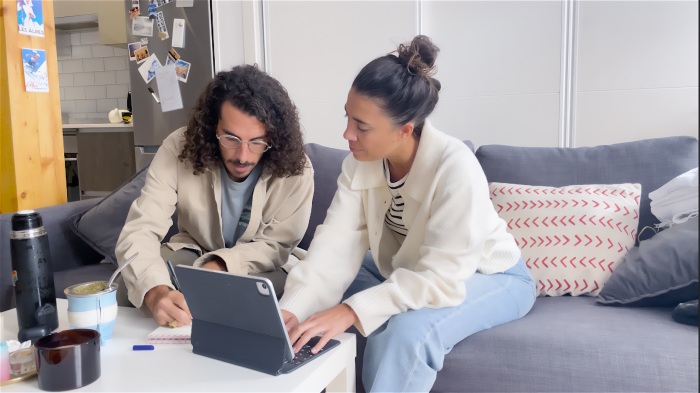
Adult beginners tend to prefer more structured media at first: films, documentaries, interviews, or short news clips. The pacing helps them breathe and process what they hear. Beginners often tell me: “I need time to think.” That’s why a slow documentary voiceover or a clear cooking video works so well. These formats allow them to connect new vocabulary with images, actions, and familiar situations.
Adult intermediate learners respond differently. The moment they stop translating and begin noticing — tone, humor, regional expressions, nuance — their progress accelerates. Intermediates thrive when they engage with content connected to their interests: travel channels, history documentaries, regional series, football interviews, or lifestyle vloggers. I’ve seen countless breakthroughs happen when a student realizes: “Oh, that’s how people actually say this,” after hearing a line in a series that rephrases something they studied months earlier. At this point, media transforms from passive exposure into confirmation of learning.
The Café Scene Breakthrough: How TV Scenes Teach Real Spanish Interaction
“Understanding Spanish is not merely decoding vocabulary. It means recognizing interaction style, pace, relational cues, and cultural habits.” – Juan Manuel Terol
One of my favorite teaching moments came from a simple café scene in a Spanish series. I played the clip for an intermediate student who understood most of the vocabulary, yet after thirty seconds he asked me: “Are they angry?” Then, “Why did he leave so fast?” And finally, “Are they arguing, or is this normal?”
Nothing in the dialogue was the problem. The confusion came from rhythm, interruptions, tone, and a level of directness that felt unfamiliar to him as an English speaker. So we watched again, shifting the focus away from “What does this word mean?” toward “What is happening between these people?” Suddenly the scene changed. The overlapping speech, quick comments, and abrupt goodbye weren’t conflict; they were signs of familiarity, urgency, and comfort — something you see constantly in series like Cuéntame cómo pasó, Merlí, or even light comedies like Paquita Salas.
This was the breakthrough: he realized that understanding Spanish is not merely decoding vocabulary. It means recognizing interaction style, pace, relational cues, and cultural habits. Vocabulary lists never teach that a quick “Bueno, me voy” with a kiss on the cheek signals routine, not tension. Nor do they show how friends speak over each other affectionately or how a rushed tone doesn’t always mean impatience.
When he stopped translating and started observing, everything clicked. From that day on, scenes that once felt intimidating began to feel familiar, and real-life Spanish — in cafés, shops, airports — became much easier to interpret.
Spanish Through Music, YouTube, Podcasts, and Social Media
Spanish lives in the rhythms people sing, the jokes creators share online, the voices you hear in interviews, and the everyday conversations inside short clips. Music, YouTube channels, podcasts, and social media posts expose learners to accents, emotions, slang, and real rhythm in a way no classroom can match. Because these formats fit naturally into daily routines, students absorb Spanish without forcing it. These are the strategies I teach most often — always grounded in real examples from lessons and real moments of breakthrough.
All the materials mentioned below —, podcasts, apps, news sources, etc. — are available in the Free Spanish Resources section of the Language Trainers website. The key is matching each resource to your level so you learn efficiently without feeling overwhelmed.
Why Music Trains Your Ear Better Than You Expect
Music offers learners something no textbook provides: emotion plus repetition. When a song moves you, you stop “studying” and start feeling the language. This explains why fans who grew up with Rebelde Way in Israel or early Shakira hits still remember entire choruses decades later. Melody unlocks memory and lowers the pressure that usually blocks listening comprehension.
Music mirrors many features of real spoken Spanish. Latin pop highlights open vowels; flamenco sharpens consonants; Colombian vallenato smooths the rhythm; Argentine rock stretches syllables in distinctive ways. These patterns help learners distinguish sounds that normally blur in fast speech, especially differences in vowel quality and consonant softness.
Pronunciation improves naturally. Listening to Natalia Lafourcade exposes learners to clear Mexican articulation, Rosalía shows how Catalan-influenced sounds blend into Spanish, and Carlos Vives brings coastal Colombian musicality that highlights syllable timing. Repeating short lines out loud becomes a form of pronunciation training that feels playful rather than mechanical.
Lyrics adapt to every level. Beginners listen for familiar words like “quiero” [I want], “tengo” [I have], or “hola” [hello], while intermediate learners follow the lyrics while listening, noticing how everyday expressions fit together. Advanced learners use songs as mini grammar labs — understanding why “me voy” [I’m leaving] feels immediate, or how metaphors shape the emotional tone of the line.
Above all, music removes pressure. You don’t analyze every second; rhythm and emotion guide you. When listening becomes enjoyable, Spanish starts to stick on its own.
Using Subtitles Without Becoming Dependent on Them
Subtitles are a powerful support, but they silently take over if learners rely on them for every scene. Many students follow the plot but absorb little rhythm, gesture, or pronunciation because they are reading rather than listening. The goal isn’t to avoid subtitles — it’s to use them intentionally.
A gradual method works best.
Start with subtitles on, especially for new series, dense documentaries, or unfamiliar accents such as Argentine or Mexican Spanish. At this stage, I encourage students to look beyond vocabulary and notice tone, pauses, speed, and body language. A character rolling their eyes communicates as clearly as dialogue.
Then shift to Spanish subtitles. This bridges sound and spelling, helping learners spot reduced articles, dropped consonants, and filler expressions such as “o sea” [I mean], “vale” [okay], “¿viste?” [you know?], or “bueno” [well].
Next comes the crucial step: subtitles-off moments.
Not for a whole episode — that overwhelms even strong listeners. Instead, choose 30 to 90 seconds of a familiar scene. Suddenly, the brain listens actively, relying on tone, verbs, rhythm, and context rather than reading. Even partial comprehension builds confidence.
Once reading disappears, visual cues take center stage. Gestures, facial expressions, pacing, and emotional tone often explain more than vocabulary. English-speaking learners are sometimes surprised by how much Spanish communication happens between the lines — and subtitles-off moments train the eye to notice it.
Over time, students switch subtitles off naturally, not out of obligation but because their ears start to lead the way. That moment is where real listening progress begins.
YouTube Channels, Podcasts, and Social Media That Boost Comprehension
YouTube, podcasts, and social media expose learners to the living language: natural pace, filler words, regional accents, humour, hesitation, and all the small details that make Spanish feel real. What makes these tools so powerful is that they allow you to control difficulty, choose content you genuinely enjoy, and revisit moments as many times as needed. With the right strategy, these platforms help you build comprehension much faster than traditional methods alone.
How to choose Spanish learning resources based on level
For beginners, the goal is clarity, repetition, and visual support. This is why channels made specifically for learners work so well. Butterfly Spanish, for example, is a teacher-led YouTube channel where grammar, vocabulary, and pronunciation are explained calmly and visually, making it perfect when you’re still training your ear. Slow-news resources listed in the Language Trainers library provide simple stories with controlled vocabulary that create confidence rather than overwhelm.
For intermediate learners, you want content that feels real but not too fast. Podcasts like Easy Spanish blend on-the-street interviews with clearer narration, which creates a bridge between structured learning and authentic language. YouTube channels that focus on lifestyle, cooking, or culture — many of which appear in Language Trainers’ recommended list — introduce colloquial language, reactions, and everyday rhythm in a manageable way. This is the stage where pausing, rewinding, and replaying become incredibly useful tools.
For advanced learners, the objective shifts from comprehension to nuance. Choose native content not aimed at learners: interviews, opinion videos, travel vlogs, comedy channels, or long-form podcasts. These formats expose you to speed, sarcasm, regional phrasing, and cultural assumptions — the things that textbooks rarely show. You don’t need to understand every detail; what matters is exposure to how Spanish actually sounds across countries.
Personalized Spanish resources matching interests
One of the biggest advantages of digital media is that you get to choose the world you learn from. If you love cooking, follow Spanish-speaking chefs. If you enjoy tech, subscribe to Latin American or Spanish reviewers. If you watch football, follow creators who discuss matches in Spanish. This personal connection matters because your brain absorbs vocabulary more easily when the topic is meaningful. A student who loves music, for example, might follow Spanish-language lyric breakdown channels or reaction videos — both of which are excellent for discovering slang, tone, and pronunciation.
This interest-based approach mirrors real-life usage: you don’t learn Spanish to perform grammar drills; you learn it to connect with the things and people you care about. Media gives you exactly that environment.
How to transition to authentic native Spanish content
Transitioning to full-speed native content requires intention, but it is easier than many learners expect. Start with familiar creators and activate Spanish subtitles — not as a crutch, but as a guide. Subtitles help your eyes and ears connect sounds with words, especially when accents are new. After that, introduce what I call controlled immersion: watch the same clip twice, first with subtitles, then without. Because your brain already understands the context, it starts filling in gaps naturally.
Short-form videos are ideal for this: 30-second reels, TikToks, or YouTube Shorts give you repeated exposure in tiny, manageable bursts. Podcasts can follow the same pattern: listen once passively (commuting, cooking), then re-listen actively to catch expressions you missed.
Over time, you’ll realize something important: comprehension doesn’t come from translating; it comes from recognition. The more your ear hears Spanish as Spanish — not as English in disguise — the faster fluency develops.
YouTube Channels, Podcasts, and Social Media That Boost Comprehension
Connecting Spanish to real voices — not scripted classroom examples — is a game-changer. Carefully chosen YouTube channels, podcasts, and social media let you hear Spanish as it’s spoken by native people, with natural rhythm, slang, and expression. Below are rich, practical ways to choose and use these resources, with examples you can start with today.

How to choose Spanish learning content based on level
For beginners, pick channels or clips with clear, slow, learner-friendly explanations and visual support. For example, Butterfly Spanish on YouTube offers short, engaging lessons covering grammar, pronunciation, and vocabulary in a friendly, accessible way — ideal when you’re still training your ear to Spanish sounds. Similarly, YouTube hosts beginner playlists like free Spanish beginner courses that group A1 topics into one long video you can revisit.
For intermediate learners, look for authentic but still structured language. Easy Spanish interviews people on the street in Latin America and Spain, with subtitles that help you notice everyday expressions, fillers, and rhythm. Channels such as How to Spanish Podcast on YouTube mix lessons with real Spanish vlogs and cultural discussions, giving intermediate learners context and variety.
Advanced learners benefit from podcasts and native content with minimal simplification because these formats mirror the pace, vocabulary density, and spontaneity of real conversation. A great example is the Duolingo Spanish Podcast, which tells true, human-interest stories through a mix of Latin American narrators and conversational interviews. The narration uses clear speech, but the inserted native audio segments preserve natural rhythm, regional accents, fillers, and emotional tone. This combination helps advanced learners push beyond “textbook comprehension” and develop real-world listening skills.
How to Choose Spanish Media That Matches Your Interests
One of the biggest advantages of modern media is choice. If you love comedy, follow Spanish-speaking comedians; if you’re into lifestyle, travel, or gaming, subscribe to creators in those niches. Spanish YouTubers like Soy una pringada from Spain offer real cultural commentary and everyday speech with expressive personality, while Argentine creator Martin Cirio showcases conversational slang, humor, and rapid informal speech — both excellent for hearing unfiltered Spanish in cultural context.
Social media platforms like TikTok and Instagram also host native-speaker content you can follow daily — from jokes and short dialogues to vocabulary insights and cultural snippets — turning passive scrolling into active learning.
How to Transition From Learner-Friendly Spanish to Authentic Native Content
Step 1: Begin With Spanish Created for Learners
Start with graded resources such as Butterfly Spanish (clear explanations of grammar and everyday expressions), Dreaming Spanish (comprehensible-input videos organized by level), or slow-paced podcasts aimed at beginners. These give you predictable vocabulary, steady pronunciation, and visual support that help build early confidence.
Step 2: Use Subtitles Strategically, Not Passively
Watch new content once with Spanish subtitles to understand the storyline and identify key words. On the second viewing, replay short segments without subtitles. This forces active listening, yet feels manageable because your brain already knows what’s happening. Subtitles become a learning tool rather than a default crutch.
Step 3: Revisit Short Clips Instead of Full Episodes
Choose 10–30 second fragments from series, YouTube videos, or interviews. Listen multiple times, repeat lines aloud, and notice features like intonation, pauses, and filler words. Short repetition builds listening muscles much faster than watching a full episode you don’t fully understand.
Step 4: Gradually Introduce Fast, Real Spanish
Move to slightly more challenging material:
• Vloggers like La Pringada (Spain) or Martín Cirio (Argentina), who speak naturally and expressively.
• Native news clips on RTVE, DW Español, or El País.
• Short documentaries or man-on-the-street interviews where speech is natural and unscripted.
Authentic rhythm, slang, and accent variation start becoming familiar instead of intimidating.
Step 5: Add Podcasts With Increasing Speed and Complexity
A great intermediate bridge is the Duolingo Spanish Podcast: real stories told in natural Spanish with slight scaffolding in English. Once that feels comfortable, transition to full native podcasts such as Radio Ambulante, Nadie Sabe Nada, or Entiende Tu Mente — no simplification, just pure Spanish.
Step 6: Reduce Subtitles, Increase Attention to Context
Begin watching entire scenes, then entire episodes, without subtitles. Don’t aim for perfection — aim for meaning. Use body language, tone, setting, and reaction cues to fill in gaps. This mirrors real-life conversation far more than translation does.
Step 7: Follow Your Interests Consistently
The most important step is enjoyment. If you love cooking, follow Spanish-speaking cooks like Robegrill, from Mexico. If you enjoy comedy, subscribe to Spanish comics. If you’re into travel, watch Latin American travel vloggers such as Isa por ahí, from Colombia. Interest creates daily exposure, and daily exposure creates fluency.
Invitation to Learn With a Native Teacher
Learning Spanish through media becomes far more effective when guided by someone who knows how to turn what you watch, hear, and enjoy into real progress. A native teacher helps you transform movies, songs, memes, interviews, and YouTube clips into structured learning moments: noticing pronunciation you missed, explaining cultural references that aren’t obvious, and showing you how to reuse vocabulary and expressions naturally in conversation. Instead of consuming Spanish passively, you learn how to interact with it — and that shift changes everything.
In one-to-one lessons, media becomes a flexible tool. A teacher can pause a scene to highlight rhythm or tone, replay a line to work on pronunciation, or turn a short clip into a speaking activity. Memes become vocabulary lessons, song lyrics become pronunciation practice, and dialogue from a series becomes a window into real conversational patterns. Because sessions are personalized, you study with content that matches your level, your interests, and your goals, not someone else’s checklist.
In-person classes take this even further. Face-to-face sessions help you fine-tune pronunciation and intonation in ways online study rarely achieves. You hear natural Spanish in real time, adjust your speech instantly with feedback, and build confidence through direct interaction — the same skills needed to understand native speakers outside the classroom. When you combine professional guidance with the media you already love, Spanish becomes more intuitive, more cultural, and more alive.
→Sign Up Now: Free Trial Spanish Lesson With a Native Teacher!←
At Language Trainers, you work with native Spanish teachers like me who build every lesson around how Spanish truly lives in the real world. Instead of memorizing lists or repeating generic dialogues, you learn through the voices, scenes, and cultural moments that make Spanish meaningful — from conversations you want to understand to the media you already enjoy. Your teacher guides you through pronunciation, rhythm, slang, and cultural nuance, and helps you transform movies, songs, podcasts, memes, or social-media clips into real, usable Spanish.
Every course is personalized. There is no fixed syllabus — we design your lessons around your goals, your level, and your preferred learning style. And because Language Trainers offers one-to-one lessons, including face-to-face private classes, you receive direct guidance, real-time feedback, and a learning experience that adapts to you rather than the other way around.
If you want to study Spanish in a way that feels natural, motivating, and connected to real life, reach out to Language Trainers today. We’ll match you with a native teacher who understands your goals and helps you build confidence from the very first lesson.
How to Learn Spanish With Media: FAQs for All Levels
1. What is the best way to start learning Spanish through movies and series?
The best way to begin learning Spanish through movies and series is to focus on comprehension, not perfection. Start with Spanish audio and Spanish subtitles, then rewatch short scenes without subtitles to train your ear to follow tone, rhythm, gestures, and context. Choose content you genuinely enjoy, because emotional engagement improves memory. Over time, this approach builds natural listening skills that traditional exercises rarely develop.
- How much Spanish can beginners realistically learn from music?
Beginners learn far more from music than they expect because repetition, melody, and emotion reinforce vocabulary and pronunciation effortlessly. Even when understanding only 20 percent of the lyrics, the brain internalizes sounds, syllable patterns, and high-frequency words like quiero, tengo, or hola. Over time, following lyrics while listening strengthens comprehension and makes pronunciation more accurate. Music becomes a low-pressure gateway to real Spanish rhythm.
- What Spanish YouTube channels work best for different levels?
Beginner learners benefit from clear, structured channels such as Butterfly Spanish, which explains grammar and pronunciation visually and at a comfortable pace. Intermediate learners improve faster with semi-authentic content like Easy Spanish, which blends real interviews with helpful narration. Advanced learners progress most through native creators such as La Pringada or Martín Cirio, whose unscripted speech exposes them to natural rhythm, slang, humor, and regional accents.
4. How do I avoid becoming dependent on subtitles when watching Spanish content?
Avoiding subtitle dependence starts with a gradual approach. Watch once with Spanish subtitles to understand context, then replay 30–90-second segments without them. Short “subtitles-off moments” force active listening while keeping the process manageable. Focus on tone, expressions, gestures, and emotional cues, not perfect word-for-word comprehension. Repeating this pattern steadily trains your ear, helping you feel more confident without relying on reading.