



I’ve been teaching Portuguese for many years, but nothing helps learners understand the language more quickly than stepping into the world of football. The moment the drums start, the chants rise, and the stadium vibrates, Portuguese stops being a school subject and becomes something living, emotional, and unforgettable. I still remember the first time I felt this as a teenager in Curitiba–half terrified, half euphoric–as two rival crowds shook the concrete beneath my feet. Long before I ever became a Portuguese teacher, football taught me how rhythm shapes our speech, how humor carries cultural meaning, and how vocabulary reveals identity, pride, and rivalry.
In this article, I’ll walk you through how football culture–chants, rivalries, stadium rituals, humor, slang, regional accents, and even everyday idioms–helps you learn Portuguese in a natural, memorable way. Everything I share here comes from experiences I’ve lived, matches I’ve attended, and moments that shaped my understanding of Portuguese as a cultural force, not just a language.
→Sign Up Now: Free Trial Portuguese Lesson With a Native Teacher!←
Why Football Is One of the Best Ways to Learn Portuguese
Football floods your brain with the very ingredients that make languages stick: repetition, rhythm, emotion, and real-world context. When 40,000 people chant the same phrase in perfect synchrony, your ear locks onto its melody and natural stress pattern. When fans shout instructions, tease rivals, or celebrate goals, you hear Portuguese exactly as people speak it–fast, emotional, full of slang, shortened forms, and a genuine local accent.
Here is why football accelerates Portuguese learning so effectively:
- The vocabulary is high-frequency and constantly recycled.
Words such as ganhar (to win), perder (to lose), jogar (to play), gol (goal), and torcida (supporters or fanbase) appear nonstop in chants, commentary, and everyday football conversations. - Chants reveal the true rhythm and intonation of the language.
Short, powerful chants like “Eu acredito!” (“I believe!”) or “Ôôô, o campeão voltou!” (“Ohhh, the champion is back!”) make you notice how Brazilians stretch vowels, raise their voice with excitement, and use melody to emphasize meaning. - Emotion enhances memory.
A word shouted in a packed stadium stays with you far longer than a word memorized from a list because excitement anchors the sound, rhythm, and meaning in your mind. - Rivalries expose humour, teasing, and slang.
Expressions such as freguês (“customer,” a joking nickname for a rival team that always loses) or vai chorar? (“are you going to cry?”) show how Brazilians mix irony, exaggeration, and playfulness in football talk. - Football media shows regional accents very clearly.
Post-match interviews, fan reactions, and commentary highlight São Paulo’s clearer articulation, Rio’s aspirated Rs, and other regional traits that learners rarely hear in textbooks.
“A word shouted in a packed stadium stays with you far longer than a word memorized from a list” – Lucas Abiko
How Chants Help You Learn Rhythm and Pronunciation in Portuguese
When I teach pronunciation, I rarely start with grammar explanations. I start with chants. A chant shows you how Portuguese truly sounds in real life. It shows where Brazilians lift their voice, how vowels stretch during excitement, and how emotion shapes meaning more than any rule in a textbook.
A classic example is “Eu acredito!” (I believe). Its short, repetitive structure highlights how stress works in Portuguese and how rising intonation adds emotional weight. The phrase becomes a lesson in natural pronunciation simply through repetition.
Another widely heard chant is “Ôôô, o campeão voltou!” (Ohhh, the champion is back). The long ôôô shows how Brazilian Portuguese stretches vowels during excitement, and the smooth connection between words helps learners grasp the flow of spoken language. Even without technical explanations, chants make it easy to hear how Brazilians link sounds together.
Chanting in a crowd or listening to stadium recordings reveals something textbooks never show. Pronunciation shifts with emotion, rhythm guides the voice, and certain sounds become more prominent when shouted collectively. These patterns help learners internalize natural pronunciation far faster than isolated word lists.
Football Rivalries Teach You Humor, Teasing, and Everyday Slang
Rivalries are where Portuguese becomes emotional, messy, funny, and deeply expressive. Fans tease, mock, exaggerate, and celebrate through language, and this playful tone gives learners a window into real Brazilian humor.
Expressions like vai chorar? (“are you going to cry?”) or freguês (“customer,” used for a rival who always loses to your team) show how teasing works as a social game rather than pure hostility. Brazilians stretch the meaning of words, flip metaphors upside down, and use irony as a way of bonding.
Other expressions push the drama even further. When one team completely dominates the match, fans shout tomou vareio! (“you got outplayed!”), a phrase full of exaggeration and theatrical flair. When the score becomes embarrassingly one-sided, virou passeio! (“this turned into a stroll!”) adds humor by pretending the match has stopped being competitive at all. At the opposite extreme, a messy, accidental goal is celebrated as a gol chorado (“a crying goal”), a phrase that teaches students how Brazilians humanize objects, add emotion to outcomes, and turn even clumsy moments into stories.
These expressions reveal how Brazilians use humor to soften rivalry, build connection, and make football language richer than literal translation. For learners, they provide cultural insight and memorable vocabulary that sticks far more effectively than memorizing lists
Everyday Brazilian Portuguese Expressions Inspired by Football
Football doesn’t stay in the stadium. Its language slips into daily conversation, work life, relationships, and problem-solving. Brazilians constantly use football expressions to talk about behavior, mistakes, success, timing, and honesty. For learners, these idioms are gold because they appear everywhere–in TV shows, office chats, family conversations, and online slang–and they teach how Brazilians think, react, and relate to each other.
Here are some of the most common expressions and what they reveal about everyday Portuguese.
- Pisar na bola (“to step on the ball”) means to mess up or disappoint someone. It applies to situations ranging from forgetting a birthday to arriving late to an important meeting.
Example sentence: “Eu pisei na bola no trabalho.” (I messed up at work.) - Baixar a bola (“to lower the ball”) tells someone to calm down or drop an arrogant attitude. The expression reflects how Brazilian Portuguese often softens criticism through metaphor.
Example sentence: “Baixa a bola aí.” (Calm down.) - Bola pra frente (“ball forward”) means to move on and keep going after a setback. It mixes optimism with practicality and is common in everyday encouragement.
Example sentence: “Errou, mas agora é bola pra frente.” (You made a mistake, but now move on.) - Aos 45 do segundo tempo (“in the 45th minute of the second half”) describes doing something at the very last minute. It adds drama to deadlines at work or school.
Example sentence: “Ele entregou o relatório aos 45 do segundo tempo.” (He submitted the report at the last minute.) - Trocar as bolas (“to swap the balls”) means to get confused or mix things up. It often refers to misunderstandings or mental slips.
Example sentence: “Troquei as bolas e fui para o lugar errado.” (I got confused and went to the wrong place.) - Jogar para escanteio (“to send something to the corner kick”) describes ignoring an issue, sidelining a person, or postponing a decision. It suggests deliberate avoidance rather than forgetfulness.
Example sentence: “Eles jogaram o problema para escanteio.” (They ignored the problem.) - Abrir o jogo (“to open the game”) means being honest or telling the truth openly. It often appears in conversations about relationships or work expectations.
Example sentence: “Vou abrir o jogo com você.” (I’m going to be honest with you.) - Comer a bola (“to eat the ball”) is a compliment used when someone performs extremely well or works very hard. It is informal and enthusiastic.
Example sentence: “Ela comeu a bola na apresentação.” (She did an amazing job in the presentation.) - Pendurar as chuteiras (“to hang up the boots”) means retiring or stepping away from a career or activity. While rooted in football, it applies to many areas of life.
Example sentence: “Depois de 30 anos, ele decidiu pendurar as chuteiras.” (After 30 years, he decided to retire.)
These idioms make Portuguese feel alive because they pack humor, imagery, and culture into short, memorable phrases. When learners start using expressions like bola pra frente or abrir o jogo naturally, they’re not just learning vocabulary–they’re stepping into a way of thinking that Brazilians use every single day.
💡 Brazilian Football Idioms: Ambassador Learning Tip
One technique I recommend to my students is creating a “football idiom map.” Any time you watch a match recap, YouTube highlight, or fan discussion, pause and write down every idiom you notice – then look at how it works in that exact moment. When you hear pisar na bola (to mess up) after a missed chance, or bola pra frente (move on / keep going) after a difficult play, the meaning sticks because it’s tied to emotion, not memorization. I suggest practicing out loud using simple, everyday contexts: Hoje eu pisei na bola (I messed up today), Vamos colocar a bola pra frente (Let’s move on), Ele quase trocou as bolas (He got things mixed up). Connecting each expression to a real-life situation helps you store it as natural language. Before long, you’ll start hearing these idioms everywhere – not only in football, but in Brazilian Portuguese conversations of all kinds.
How Football Vocabulary Reinforces Real Brazilian Portuguese Grammar
Football language sits at the heart of everyday Brazilian Portuguese, and one reason it works so well for learners is repetition. Stadium chants, match commentary, post-game interviews, and casual conversations repeat the same high-frequency verbs endlessly. Words like ganhar (to win), perder (to lose), jogar (to play), fazer gol (to score), and defender (to defend) appear so often that learners absorb them naturally, without forcing memorization.
This grammar exposure isn’t abstract – it’s emotional. When a commentator shouts “Ele fez o gol!” (He scored the goal) or fans scream “A gente ganhou!” (We won), learners hear real conjugations carried by enthusiasm rather than grammar drills. Even more useful are structures that repeat in match summaries, such as ganha / ganhou, perde / perdeu, faz / fez, which highlight present versus past tense in a meaningful way.
Brazil’s football culture multiplies this effect. Whether it’s kids playing a pelada (casual neighborhood match) on a Sunday morning, friends teasing one another after a derby, or crowds chanting “Eu acredito!” (I believe we can still win), the same verbs and structures circulate everywhere. This mirrors what cultural historians note about football in Brazil: it operates as a national language of emotion, storytelling, and identity.
In lessons, short match recaps, goal reactions, or simple fan expressions help anchor conjugations. Instead of memorizing verb tables, students work with sentences like “O time perdeu no último minuto” (The team lost in the last minute) or “Ele defende muito bem” (He defends very well). These patterns reflect natural speech, making grammar intuitive.
Football’s connection to jogo bonito (the beautiful game) – creativity, rhythm, improvisation – amplifies this process. Once grammar is tied to emotion and culture, it stops feeling like a rule and becomes a living pattern learners internalize effortlessly.
Vocabulary Takeaway: High-Frequency Football Verbs and Expressions
- ganhar — to win
- perder — to lose
- jogar — to play
- fazer gol — to score
- defender — to defend
- empatar — to draw / to tie
- marcar — to score / to mark an opponent
- tomar gol — to concede a goal
- apitar — to blow the whistle / to referee
- driblar — to dribble / to dodge
These are the verbs and actions that repeat constantly in stadium chants, match commentary, news coverage, and fan conversations — the ideal material for internalizing real grammar patterns without memorization.
💡 Ambassador Learning Tip: How I Use Football to Teach Verb Forms
I often ask students to choose a short highlight clip — sometimes 20 or 30 seconds is enough — and write down every verb they hear from the commentator. Football commentary uses clear, energetic conjugations like fez (did/scored), ganhou (won), perdeu (lost), or defendeu (defended). Once the list is ready, we turn each verb into two or three everyday sentences, so students see how a sports phrase becomes general Portuguese. This transforms grammar into something familiar and memorable. Watching the same clip again after the exercise reinforces the forms instantly, and students feel the rhythm of real Brazilian Portuguese rather than isolated rules.
Why Brazilians Are So Passionate About Football – And What Learners Discover Through Its Language
To understand Brazilian Portuguese deeply, you need to understand why football carries such enormous emotional weight in Brazil. It is not just a sport – it is a cultural force shaping identity, history, art, community, and even politics. Football functions almost like an emotional language, spoken collectively, instinctively, and expressively.
Historically, football became a tool for social mobility, artistic expression, and national pride. Brazil’s iconic style – jogo bonito (the beautiful game) – reflects creativity, improvisation, and joy. This style grew from Afro-Brazilian cultural traditions such as samba, capoeira, and malandragem (street-smart cleverness), blending rhythm, mischief, elegance, and resistance. Commentators often call the sport “samba on the pitch,” combining art with athletics.
Brazilian legends like Pelé, Zico, Romário, Garrincha – o anjo das pernas tortas (the angel with crooked legs) – and Neymar turned this style into a global symbol. Campaigns like Nike’s Joga Bonito brought football’s aesthetic to the world, while music such as Mas Que Nada strengthened the connection between rhythm and identity.
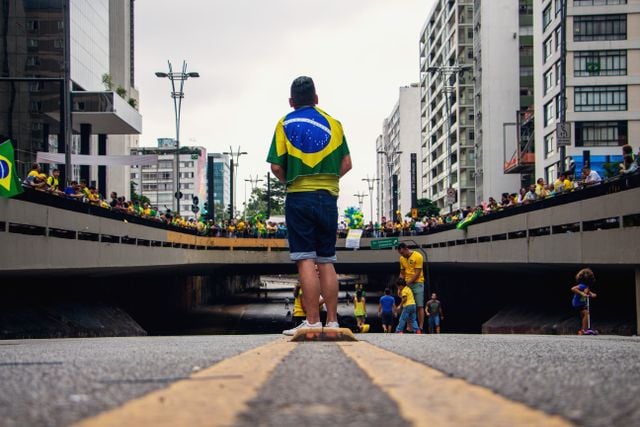
Emotion is everywhere. During World Cups, cities shut down, neighborhoods decorate entire streets, and families gather as if for a national festival. The national jersey, the amarelinha (little yellow one), symbolizes unity – and sometimes political tension – reinforcing football’s importance beyond the pitch. Inside the Maracanã, collective shouting, crying, laughing, and chanting become rituals of shared identity.
When learners explore football language, they uncover key Brazilian values:
- Openness and emotional honesty. Crowds express everything – joy, frustration, hope – with intensity that shapes pronunciation, rhythm, and intonation.
- Humor and irony. Phrases like freguês (a rival who always loses) or vai chorar? (are you going to cry?) show how teasing builds social connection rather than conflict.
- Collective identity. Chants such as “Ôôô, o campeão voltou!” (Ohhh, the champion is back!) unite strangers instantly. Regional accents surface too – São Paulo’s clarity, Rio’s aspirated R, and Northeastern melody – revealing Brazil’s linguistic diversity.
- Resilience and cultural pride. From the trauma of the Maracanazo – Brazil’s shocking 1950 World Cup final loss to Uruguay in the Maracanã Stadium – to the joy of modern celebrations, football narrates national struggle and triumph. Goal celebrations – like Neymar’s and Richarlison’s funk-inspired dances in 2022 – express joy, resistance, and cultural identity.
“Football functions almost like an emotional language, spoken collectively, instinctively, and expressively.” – Lucas Abiko
Learning Brazilian Portuguese becomes far more meaningful when you approach it not just as a language, but as a living cultural experience. Football is one of the clearest examples of this: chants, idioms, humor, regional accents, and emotional expression all reveal how Brazilians actually speak day to day. At Language Trainers, our native-speaking Portuguese teachers build lessons around this cultural perspective. If football motivates you, your teacher will happily integrate chants, interviews, memes, match commentary, or even regional accent comparisons into your sessions. Because every course is fully personalized, one-to-one, and available face to face, you learn the Portuguese that fits your interests, your goals, and the real situations where you want to communicate.
→Sign Up Now: Free Trial Portuguese Lesson With a Native Teacher!←
If you’re ready to learn Portuguese in a way that feels natural, culturally rich, and genuinely enjoyable, contact Language Trainers today — we’d be happy to match you with a native teacher who brings the language to life.
Frequently Asked Questions About Brazilian Football Culture and Language
1. Why Is Football So Important in Brazilian Culture?
Football holds a central place in Brazilian culture because it blends identity, history, community, and joy. From neighborhood peladas to the global stage, the sport symbolizes creativity (jogo bonito), social mobility, and collective pride. Fans express emotion through chants, humor, and celebration, and major events like the Maracanazo shaped national memory. Football appears in Brazilian music, politics, and daily conversation, becoming a shared emotional language across generations.
2. What Brazilian Portuguese Expressions Come from Football?
Brazilian Portuguese uses many idioms rooted in football, such as pisar na bola (to mess up), bola pra frente (move on), jogar para escanteio (set something aside), and pendurar as chuteiras (retire). These phrases appear in everyday speech far beyond sports. They teach learners how Brazilians use humor, metaphor, and rhythm to express frustration, resilience, or encouragement, giving insights into communication styles shaped by football culture.
3. How Does Football Help You Learn Brazilian Portuguese Faster?
Football accelerates learning by exposing students to high-frequency verbs, emotional repetition, and natural pronunciation. Chants reinforce rhythm and stress patterns, commentary recycles verbs like ganhar, perder, and fazer gol, and interviews introduce real regional accents. Rivalries and memes teach humor, teasing, and slang in meaningful contexts. Because football vocabulary is tied to emotion, learners remember structures and expressions more easily than through traditional memorization.
4. What Are the Main Regional Accent Differences Shown Through Brazilian Football?
Football highlights clear regional differences: São Paulo speech tends to be more neutral and easier for learners to follow, Rio de Janeiro features aspirated Rs, and southern states often avoid D/T palatalization found elsewhere. Post-match interviews and fan reactions reveal these patterns naturally. Learners hear how pronunciation shifts with geography, helping them understand why Brazilian Portuguese varies widely while staying mutually intelligible across regions.
5. What Is “Jogo Bonito” and Why Does It Matter for Learning Portuguese?
Jogo bonito (“the beautiful game”) describes Brazil’s creative, fluid football style rooted in samba, capoeira, and Afro-Brazilian cultural traditions. It represents improvisation, rhythm, and emotional expression—qualities that shape Brazilian communication. Understanding jogo bonito helps learners grasp cultural values like resilience, artistry, and spontaneity. It also explains why Brazilian Portuguese is rich in expressive verbs, celebratory chants, and playful slang that reflect movement and emotion.