


Mongolian is a fascinating language for learners because it feels familiar and unfamiliar at the same time. If you have seen written Mongolian in Mongolia, you may have noticed Cyrillic letters that look a little like Russian. If you have seen traditional Mongolian script, you may remember its beautiful vertical shape. Then, once you begin studying, you discover that the grammar works very differently from English: verbs often come at the end, suffixes carry a lot of meaning, and pronunciation rules can change how words sound in real conversation.
That can sound intimidating, but it should not discourage you. Mongolian becomes much easier when you understand its main features from the beginning. You do not need to master every case ending or verb form immediately. What you need first is a clear map of how the language works.
This guide introduces the essentials every learner should know: where Mongolian is spoken, how it relates to other languages, and how Mongolian in Mongolia differs from Mongolian in Inner Mongolia. Later, we will also look at the writing systems, pronunciation, grammar, useful phrases, and practical ways to start learning Mongolian effectively.
→Sign Up Now: Free Trial Mongolian Lesson With a Native Teacher!←
What Is the Mongolian Language?
Mongolian is the main language of Mongolia and the best-known member of the Mongolic language family. It is spoken by the vast majority of people in Mongolia and by Mongol communities in China, especially in Inner Mongolia, as well as by communities in other regions and countries.
For beginners, the most important variety to know is Khalkha Mongolian. This is the standard variety used in Mongolia, and it is the form most learners study if they are preparing to travel, work, live, or communicate in Mongolia. Most modern textbooks, online courses, public signs, media, and everyday written materials in Mongolia use the Cyrillic alphabet and are based on Khalkha Mongolian.
Mongolian is an agglutinative language, which means it builds meaning by adding suffixes to words. This is one of the biggest differences from English. In English, we often use separate words such as to, from, with, or of. In Mongolian, many of those meanings are shown by endings attached to the noun. For example, a suffix can show whether something is the destination, the object, the possession, or the tool used to do something.
This is why Mongolian can feel very logical once you get used to it. The language has patterns. The challenge is that those patterns are not the same ones English speakers expect.
Is Mongolian in Mongolia and Inner Mongolia the Same?
Mongolian in Mongolia and Mongolian in Inner Mongolia are closely related, but they are not exactly the same in everyday use. Learners will notice differences in pronunciation, vocabulary, dialects, and writing systems.
In Mongolia, the standard language is based on Khalkha Mongolian, and it is normally written in the Mongolian Cyrillic alphabet. This is the variety you will usually hear in Ulaanbaatar, in national media, in schools, and in most modern learning materials for the country of Mongolia.
In Inner Mongolia, which is an autonomous region of China, Mongolian is more dialectally diverse and is commonly associated with the traditional vertical Mongolian script. This script is culturally very important and continues to be used in Inner Mongolia today. Learners may also see different romanizations online because there is no single perfect way to write Mongolian sounds with English letters.
So, if you are a beginner, the best starting point depends on your goal. If you want to visit Mongolia, speak with people in Ulaanbaatar, or follow most modern beginner courses, Khalkha Mongolian in Cyrillic is usually the most practical choice. If your interest is Inner Mongolia, traditional script, or Mongolian literary and cultural history, you may eventually want to study the vertical script as well.
A simple way to think about it is this: the language is shared, but the standard variety, script habits, and regional speech can differ.
The Mongolian Alphabet and Writing Systems
One of the first things learners notice about Mongolian is that it can appear in two very different writing systems. If you study modern Mongolian used in Mongolia today, you will usually learn the Mongolian Cyrillic alphabet. If you explore Mongolian history, literature, or the language as used in Inner Mongolia, you will also encounter the traditional Mongolian script, written vertically.
For beginners, this can seem confusing at first, but it is actually manageable once you know which system matches your goal. Most learners who want to communicate in present-day Mongolia begin with Cyrillic, because that is what they will see in textbooks, signs, menus, government forms, websites, and everyday media. Traditional script is equally important culturally, but it usually comes later unless a learner has a specific interest in history, calligraphy, or Inner Mongolia.
The Mongolian Cyrillic Alphabet
The Mongolian Cyrillic alphabet has been the main writing system in Mongolia since the twentieth century. It is based on Cyrillic, so some of its letters may look familiar to people who have seen Russian, but Mongolian uses the script for its own sound system and includes letters that are especially important for Mongolian pronunciation.
A few examples make this easier to see:
- Монгол = Mongol / Mongolia-related word root
- Сайн байна уу? = Hello / How are you?
- Баярлалаа = Thank you
For English-speaking learners, the most important thing is not to assume that every Cyrillic letter works exactly as it would in Russian, or that every sound will match English habits. Mongolian also uses the letters Ө ө and Ү ү, which represent vowels that do not exist in standard English and need special attention in pronunciation practice.
For example:
- ө appears in words such as өнөөдөр (today)
- ү appears in words such as үндэс (root, base, or foundation)
These vowels are one reason pronunciation matters so much in Mongolian. A learner may be able to read the letters, but still need training to produce the sounds naturally.
Another useful point is that Cyrillic makes Mongolian look more complicated than it really is. Once learners know the alphabet, they can read a great deal quite quickly. The bigger challenge is not recognizing the letters, but understanding pronunciation rules, vowel harmony, and the way unstressed vowels may be reduced or dropped in real speech.
So, for most beginners, the practical advice is simple: start with Cyrillic if your goal is modern spoken and written Mongolian in Mongolia. It is the system you are most likely to need first.
Traditional Mongolian Script
The traditional Mongolian script is one of the most visually distinctive writing systems in the world. Unlike Cyrillic, it is written vertically from top to bottom, with columns read from left to right. Historically, it was used across the Mongolian world long before Cyrillic was adopted in Mongolia, and it remains an important symbol of Mongolian cultural identity.
A simple example is the word Mongol / Mongolian:
- Cyrillic: Монгол
- Traditional script: ᠮᠣᠩᠭᠣᠯ
Another familiar phrase is Сайн байна уу? (Hello / How are you?), which in traditional script may appear as:
- ᠰᠠᠶᠢᠨ ᠪᠠᠢᠨᠠ ᠤᠤ
Even if a learner does not study the script immediately, it is worth recognizing it when they see it, because it appears in cultural materials, artwork, historical references, and education related to Mongolian heritage. It also continues to be used in Inner Mongolia, where traditional script remains highly visible.
Culturally, the script matters because it connects modern learners to a much longer Mongolian literary and historical tradition. It is not simply an “old alphabet.” It represents a different visual worldview, one that many Mongolians still value deeply as part of their identity.
For beginners, however, the key point is practical: traditional Mongolian script is important to know about, but Cyrillic is usually the first system to study if your immediate goal is communication in Mongolia today. Later, if you continue with the language, learning some traditional script can greatly deepen your understanding of Mongolian culture and history.
What Are the Most Essential Mongolian Pronunciation Rules?
Mongolian pronunciation is one of the areas where beginners benefit most from early guidance. Learning the alphabet is important, but it is only the first step. Some vowels are long, some are short, some vowels become very weak in everyday speech, and vowel harmony affects the way suffixes attach to words.
This is why a Mongolian word may look longer on the page than it sounds when a native speaker says it. For example, learners often expect Сайн байна уу? [Hello / How are you?] or Баярлалаа [Thank you] to be pronounced exactly syllable by syllable. In real speech, however, some short vowels are reduced or dropped, so the spoken rhythm can feel faster and more compact than the written form suggests.
For learners, the goal is not to sound perfect on day one. The goal is to understand the patterns that affect comprehension. If you learn long vowels, vowel harmony, difficult vowel sounds, and the reduction of unstressed short vowels early, Mongolian becomes much easier to hear and pronounce.
Mongolian Vowels and Vowel Harmony
Mongolian vowels are not random. They follow a pattern called vowel harmony, which means that the vowels in a word influence the vowels used in suffixes. This matters because Mongolian uses many suffixes to express meanings that English often expresses with separate words.
A simple example is the present habitual ending. Depending on the vowels in the verb, the ending may appear as -даг, -дэг, -дог, or -дөг. These forms do similar grammatical work, but the vowel changes to match the sound pattern of the word.
For example:
сурдаг
[studies / learns regularly]
явдаг
[goes regularly]
үздэг
[watches / sees regularly]
The same idea appears across the language. When you add case endings, verb endings, or other suffixes, Mongolian often adjusts the vowel in the suffix so the word sounds natural. This is why learners should not treat suffixes as one fixed spelling. A suffix often has several forms, and the correct one depends on the vowels in the word.
A useful beginner rule is to pay attention to the main vowels in the word. Words with vowels such as а, о, or у often take one set of suffix vowels, while words with э, ө, or ү take another. The vowel и can behave differently depending on the word, so learners should look carefully at examples rather than guessing too quickly.
This may sound technical, but it becomes practical very quickly. If you know that suffixes change according to vowel harmony, forms like -тай, -тэй, and -той begin to make sense. They are not three unrelated endings. They are related forms shaped by the vowels in the word.
For example:
найзтай
[with a friend]
гэртэй
[with a home / has a home]
морьтой
[with a horse / has a horse]
Vowel harmony is one of the reasons Mongolian can feel logical once you understand the pattern. The language is not adding endings randomly. It is making the suffix fit the sound of the word.
Difficult Mongolian Sounds for English Speakers
Some Mongolian sounds are difficult for English speakers because they do not match familiar English sounds. The most important ones to practise early are the additional Cyrillic vowels ө and ү, long vowels, diphthongs, and certain consonants such as х, р, and нг.
The vowel ө can be challenging because it is not the same as English “o.” To pronounce it, start by saying a short e sound, like the vowel in bed, but round your lips as if you were saying o. Your tongue stays more forward in the mouth, while your lips make a rounded shape. This is what teachers mean when they call it a “rounded front vowel”: the tongue is placed toward the front of the mouth, but the lips are rounded.
You will see ө in words such as:
өнөөдөр
[today]
мөр
[trace / line / shoulder, depending on context]
The vowel ү is also unfamiliar to many English speakers. To imitate it, start with the ee sound in see, then round your lips tightly as if you were saying oo. The tongue stays forward, but the lips are rounded. If you know French or German, it is similar to the sound in French tu or German über.
You will hear ү in words such as:
үндэс
[root / foundation]
сүү
[milk]
Long vowels are especially important because vowel length can change meaning. A short vowel and a long vowel are not just two versions of the same sound. They can create different words.
For example:
цас
[snow]
цаас
[paper]
The difference is the length of the vowel. In цаас [paper], the vowel is held longer. If learners pronounce it too short, they may be saying a different word from the one they intended.
Diphthongs, or combined vowel sounds, also need careful listening. A diphthong is a vowel sound that moves from one position to another inside the same syllable. English has diphthongs too: the vowel in my starts in one place and moves toward another. Mongolian has similar moving vowel sounds.
A common example is ай, as in:
баяртай
[goodbye]
Here, ай should not be pronounced as two slow, separate vowels. It is smoother, more like one moving sound. This is why listening and repetition matter so much.
Another major pronunciation point is the reduction or dropping of short unstressed vowels. Mongolian words often place stress near the beginning, and later short vowels may become very weak or disappear in fast speech. This means a word may be written with several short vowels, but pronounced with fewer clear syllables.
For example, a learner may try to pronounce every vowel in Баярлалаа [Thank you] very carefully. In natural speech, some of those vowel sounds are much lighter, so the word sounds more compact. This is not careless pronunciation. It is part of the rhythm of Mongolian.
The consonant х also deserves attention. It is often written as kh in romanization, but it is not the same as English k. To make this sound, push air through the back of your mouth, almost like a strong, rough h. It is similar to the sound in German Bach or Scottish loch.
For example:
хот
[city]
хүн
[person]
Finally, learners should pay attention to нг, which can sound like the ng in English song. It is usually better not to pronounce it as a clear n plus g. Try to treat it as one sound made at the back of the mouth.
The most helpful habit is simple: do not learn Mongolian pronunciation only from spelling. Listen, repeat, record yourself, and compare your pronunciation with a native speaker. Mongolian pronunciation has patterns, but your ear needs time to recognize them.
How Mongolian Grammar Works
Mongolian grammar can feel very different from English at first, but it is not chaotic. In fact, once learners understand a few basic principles, Mongolian becomes much more predictable. The language relies heavily on word order and suffixes, which means the position of a word and the ending attached to it often tell you what role that word plays in the sentence.
A suffix is a small ending added to a word. English uses suffixes too, such as -ed in walked or -s in books, but Mongolian uses them much more widely. Instead of using many separate words like to, from, with, or of, Mongolian often adds endings directly to nouns and verbs.
This is one of the first grammar shifts beginners need to make. Mongolian is not built by translating English word for word. It has its own structure, and that structure is usually quite logical once you learn where to look.
Mongolian Word Order
The basic Mongolian word order is subject-object-verb. This means the person or thing doing the action usually comes first, the object usually comes next, and the verb normally comes at the end.
In English, we usually say:
I read a book.
The order is:
I = subject
read = verb
a book = object
In Mongolian, the order is different:
Би ном уншдаг.
[I book read.]
Meaning: [I read a book.]
Here, Би [I] is the subject, ном [book] is the object, and уншдаг [read / usually read] is the verb. The verb comes at the end.
This can be surprising for English speakers because the verb often carries the main action of the sentence. In Mongolian, you may have to wait until the end to know what happened.
For example:
Би өглөө кофе уудаг.
[I morning coffee drink.]
Meaning: [I drink coffee in the morning.]
The sentence follows a useful pattern:
Subject + Time + Object + Verb
So:
Би [I]
өглөө [in the morning]
кофе [coffee]
уудаг [drink / usually drink]
This is why some learners use the memory aid STOP:
S = Subject
T = Time
O = Object
P = Predicate, meaning the verb or main action
A predicate is the part of the sentence that tells us what the subject does or what happens. In a simple Mongolian sentence, this is usually the verb at the end.
Here are a few more examples:
Би монгол хэл сурдаг.
[I Mongolian language study.]
Meaning: [I study Mongolian.]
Би хоол хийдэг.
[I food make.]
Meaning: [I cook.]
Би өдөр бүр ном уншдаг.
[I every day book read.]
Meaning: [I read a book every day.]
The good news is that once you get used to waiting for the verb, Mongolian sentence structure becomes easier to follow. Instead of asking, “Where is the verb?”, train yourself to listen until the end.
Mongolian Cases and Suffixes
One of the most important concepts in Mongolian grammar is case. A case is a grammar form that shows the role of a noun in a sentence. In English, we often show these relationships with prepositions such as to, from, with, of, or in. In Mongolian, these meanings are often shown with suffixes attached to the noun.
For example, in English we say:
to school
Mongolian adds an ending to the word сургууль [school]:
сургуульд
[to school / at school]
The suffix -д shows direction or location. So instead of using a separate word like to, Mongolian attaches the meaning to the noun.
Another example:
ном
[book]
номыг
[the book — as the direct object]
A direct object is the thing that receives the action. In the sentence I read the book, the book is the direct object because it is the thing being read.
In Mongolian:
Би номыг уншина.
[I book read.]
Meaning: [I will read the book.]
The suffix -ыг marks ном [book] as the object of the verb.
Mongolian has several important cases, but beginners do not need to master them all at once. What matters first is understanding what cases do. They help answer questions such as:
Who owns it?
Where is it?
Where is it going?
Where is it coming from?
What is receiving the action?
Who or what is it with?
What tool is being used?
For example:
номын
[of the book / the book’s]
гэрт
[at home / to home]
сургуулиас
[from school]
үзгээр
[with a pen]
найзтай
[with a friend]
These endings are small, but they carry a lot of meaning. This is why Mongolian learners should pay attention to the end of words. In English, we often look before the noun for words like to or from. In Mongolian, the clue usually comes after the noun.
Suffixes also change according to vowel harmony. This means the vowel inside the suffix often adjusts to match the vowels in the main word. For example, the ending meaning with can appear as -тай, -тэй, or -той, depending on the word.
найзтай
[with a friend]
гэртэй
[with a home / has a home]
морьтой
[with a horse / has a horse]
The pattern may look strange at first, but it is not random. Mongolian is matching the suffix to the sound of the word.
Mongolian Verbs and Tenses
Mongolian verbs usually come at the end of the sentence, and their endings show important information such as time, habit, possibility, intention, or mood.
A verb is an action or state word, such as go, read, eat, study, or be. A tense tells us when the action happens: past, present, or future. Mongolian expresses tense by adding suffixes to the verb stem.
The verb stem is the basic part of the verb before endings are added. For example, in English, walk is the stem in walked, walking, and walks. Mongolian works in a similar way, but with its own set of endings.
One common present habitual form uses -даг, -дэг, -дог, or -дөг. This form is used for things people do regularly or generally.
Би монгол хэл сурдаг.
[I Mongolian language study.]
Meaning: [I study Mongolian.]
Би өглөө кофе уудаг.
[I morning coffee drink.]
Meaning: [I drink coffee in the morning.]
For past actions, Mongolian often uses endings such as -сан, -сэн, -сон, or -сөн, depending on vowel harmony.
Би өчигдөр ажилласан.
[I yesterday worked.]
Meaning: [I worked yesterday.]
Би өчигдөр монгол хэл сурсан.
[I yesterday Mongolian language studied.]
Meaning: [I studied Mongolian yesterday.]
For future actions, Mongolian often uses endings such as -на, -нэ, -но, or -нө.
Би маргааш ажиллана.
[I tomorrow will work.]
Meaning: [I will work tomorrow.]
Би маргааш хоол хийнэ.
[I tomorrow food will make.]
Meaning: [I will cook tomorrow.]
Mongolian also uses verb forms to express ideas that English may express with extra words. For example, learners will later meet forms for must, can, want to, like to, if, because, and in order to.
For now, the main thing to remember is this: Mongolian verbs carry a lot of information at the end of the sentence. If you are listening to Mongolian, do not stop halfway through. The final verb often tells you whether the sentence is about the past, the future, a habit, a wish, a need, or a possibility.
That may feel difficult at first, but it also gives Mongolian a clear rhythm. Once learners begin recognizing common verb endings, full sentences start to feel much easier to understand.
Essential Mongolian Words and Phrases for Beginners
Learning a few beginner Mongolian words and phrases early can make the language feel much more approachable. Even before you understand all the grammar, simple expressions help you greet people, show politeness, ask for help, and take part in everyday interactions.
This is also a good way to connect the language to real situations. A beginner who can say Сайн байна уу? (Sain baina uu?) [Hello / How are you?], Баярлалаа (Bayarlalaa) [Thank you], and Уучлаарай (Uuchlaarai) [Excuse me / Sorry] already has tools for basic communication. These phrases may look short, but they introduce important pronunciation patterns, polite forms, and everyday rhythm.
For a deeper list of practical expressions, you can also explore our existing Mongolian language blog, where we cover useful Mongolian phrases for travel, greetings, and everyday situations.
Below you’ll find some Mongolian words and phrases for beginners.
Mongolian Greetings and Introductions
Greetings are usually the first phrases learners need because they open almost every conversation. In Mongolian, the most common general greeting is:
Сайн байна уу?
Sain baina uu?
[Hello / How are you?]
This is a polite and widely useful phrase. You can use it when meeting someone for the first time, entering a shop, speaking to a teacher, or greeting someone in a more formal situation.
A shorter and more casual version is:
Сайн уу?
Sain uu?
[Hi / Are you well?]
This is better for friends, people your age, or relaxed situations.
To answer, you can say:
Сайн, баярлалаа.
Sain, bayarlalaa.
[Good, thank you.]
The word баярлалаа (bayarlalaa) [thank you] is one of the most important Mongolian words for beginners. You will use it constantly: after receiving help, buying something, ordering food, or ending a short exchange politely.
Another useful expression is:
Уучлаарай.
Uuchlaarai.
[Excuse me / Sorry.]
This phrase is very practical because it works in several situations. You can use it to get someone’s attention, apologize, or politely interrupt.
For introductions, start with simple patterns:
Намайг Сара гэдэг.
Namaig Sara gedeg.
[My name is Sarah.]
Би Англиас ирсэн.
Bi Anglias irsen.
[I am from England.]
Би монгол хэл сурч байна.
Bi mongol khel surch baina.
[I am learning Mongolian.]
That last sentence is especially useful for learners because it explains why you may speak slowly or need help. Many people are patient when they understand that you are learning.
You can also learn:
Танилцсандаа таатай байна.
Taniltssandaa taatai baina.
[Nice to meet you.]
This is a slightly longer phrase, but it is useful in polite introductions, lessons, meetings, and social situations.
Travel and Everyday Communication in the Mongolian Language
Travel phrases help learners move from memorizing words to using Mongolian in real life. If you are visiting Mongolia, you may need language for taxis, directions, shops, restaurants, hotels, and asking for help.
A useful beginner question is:
Энэ юу вэ?
Ene yuu ve?
[What is this?]
This phrase helps you learn more vocabulary naturally. You can point to an object, food item, sign, or product and ask what it is.
For shopping or markets, you can say:
Энэ хэд вэ?
Ene khed ve?
[How much is this?]
This is short, practical, and easy to reuse. You can use it for food, souvenirs, tickets, or everyday items.
For directions, these phrases are useful:
Хаана байна вэ?
Khaana baina ve?
[Where is it?]
Жорлон хаана байна вэ?
Jorlon khaana baina ve?
[Where is the toilet?]
Буудал хаана байна вэ?
Buudal khaana baina ve?
[Where is the hotel?]
The word хаана (khaana) [where] is very useful because it appears in many questions.
For transport, you might need:
Такси хэрэгтэй байна.
Taksi kheregtei baina.
[I need a taxi.]
Автобус хаанаас явдаг вэ?
Avtobus khaanaas yavdag ve?
[Where does the bus leave from?]
For food and restaurants, beginners can start with:
Цэс байна уу?
Tses baina uu?
[Do you have a menu?]
Ус авъя.
Us av’ya.
[I’ll have water.]
Кофе авъя.
Kofe av’ya.
[I’ll have coffee.]
The phrase авъя (av’ya) [I’ll take / I’ll have] is useful when ordering or buying something. Once you know the pattern, you can change the noun before it.
For help, learn:
Туслаач.
Tuslaach.
[Please help.]
Та англиар ярьдаг уу?
Ta angliar yaridag uu?
[Do you speak English?]
Би сайн ойлгохгүй байна.
Bi sain oilgokhgui baina.
[I don’t understand well.]
These phrases are important because they give you a way to keep communication going, even when your Mongolian is limited.
The best way to practise beginner phrases is not to memorize a long list at once. Start with five or six expressions you can imagine using immediately. Say them out loud, listen to native pronunciation, and try replacing one word at a time. That is how phrases become real communication rather than vocabulary on a page.
NOTE: Romanization is included here only as a pronunciation guide. Mongolian sounds do not always match English spelling exactly, so listening to native pronunciation is still important.
How to Learn Mongolian Effectively: Courses, Media, and Native Teachers
Learning Mongolian effectively means combining structure with regular exposure. A phrasebook, app, podcast, film, or playlist can all help, but Mongolian is not the kind of language most learners can simply “pick up” casually. The alphabet, pronunciation, vowel harmony, suffixes, cases, and sentence structure all become easier when you have a clear plan.
That does not mean your study routine needs to be intense. In fact, beginners often make better progress when they choose a few realistic habits and repeat them consistently. A good learning plan might include one structured lesson each week, short vocabulary review, listening practice with music or podcasts, and a few minutes of speaking out loud.
The most important thing is to avoid collecting resources without using them. It is easy to download apps, open grammar pages, save videos, save songs, and feel productive. But real progress comes from turning those resources into practice: saying phrases aloud, writing short sentences, asking questions, listening again, and receiving correction.
Learn Mongolian Through Music, Films, and Podcasts
Authentic media can help learners get used to the sound, rhythm, and culture of Mongolian. This is especially important because pronunciation is not always obvious from spelling. A word may look manageable in Cyrillic, but sound faster or more compact when spoken naturally.
Music is a good starting point because repetition happens naturally. When you like a song, you listen to it more than once, and that repeated listening helps your ear notice familiar sounds, words, and sentence endings. At first, you may only recognize a greeting, a repeated verb, or a word you have studied before. That still counts as progress.
To make this practical, we recommend using our Mongolian Spotify playlist as a listening resource. You can use it actively by choosing one song, listening several times, writing down words you recognize, and then checking lyrics or asking your teacher about repeated phrases. You can also use it passively in the background, simply to become more familiar with the sound of Mongolian.
Podcasts are useful in a different way because they expose learners to spoken explanations, repeated vocabulary, and cultural context. A good option for beginners is Mongolian Made Easy, a podcast designed for people who want easy-to-follow listening practice. Episodes cover topics such as greetings, numbers, food, music, history, useful phrases, grammar tips, vocabulary, and cultural insights from a native Mongolian speaker. For a beginner, this kind of podcast is helpful because it does not expect you to understand fast native conversation immediately. It gives you a bridge between study material and real listening.
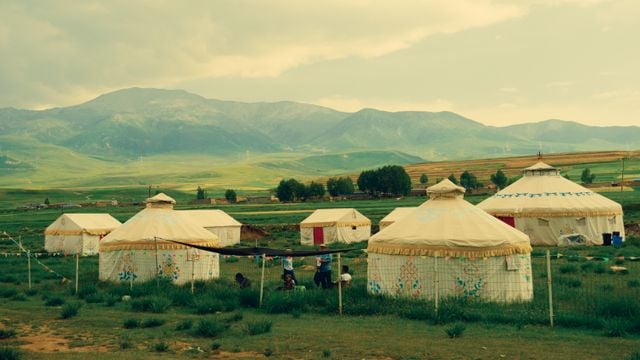
Films can also support cultural learning. They show landscapes, family life, gestures, silence, humor, social expectations, and everyday rhythm in a way that a vocabulary list cannot. Two especially useful films for learners interested in Mongolian culture are The Story of the Weeping Camel and The Cave of the Yellow Dog.
The Story of the Weeping Camel (2003) is an Oscar-nominated docudrama about a nomadic family in the Gobi Desert. The story follows a mother camel that rejects her newborn colt, and the family’s attempt to help them bond through a traditional musical ritual. For learners, the film is valuable not only because of the language, but because it introduces themes connected to nomadic life, animals, family cooperation, music, and traditional knowledge.
The Cave of the Yellow Dog (2005), also by Byambasuren Davaa, follows a young nomadic girl who finds a stray dog and wants to keep it, despite her father’s concerns. It is a gentle and accessible film, especially useful for learners who want to see family life, rural Mongolia, children’s speech, and the relationship between people, animals, and landscape.
The key is not to turn every song, podcast, or film into a full lesson. Media works best when it keeps the language present in your life between more structured study sessions. Watch with subtitles if needed, listen more than once, and collect a few useful words or phrases each time.
Build a Consistent Mongolian Study Routine
Consistency is more useful than occasional bursts of motivation. Mongolian has many new patterns for English speakers, so it is better to practise a little several times a week than to wait for one long study session.
A simple routine could look like this:
One lesson a week with a teacher
Ten minutes of vocabulary review three or four times a week
One short listening activity, such as a song or podcast clip
A scene from a Mongolian film once or twice a week
A few spoken phrases repeated out loud each day
One short written sentence using a structure you have learned
For example, after learning the sentence pattern Би монгол хэл сурч байна (Bi mongol khel surch baina) [I am learning Mongolian], you can practise changing one part:
Би кофе ууж байна.
Bi kofe uuj baina.
[I am drinking coffee.]
Би ном уншиж байна.
Bi nom unshij baina.
[I am reading a book.]
Би хөгжим сонсож байна.
Bi khögjim sonsoj baina.
[I am listening to music.]
This kind of practice is simple, but it helps you build fluency because you are not memorizing isolated words. You are learning how to create sentences.
A good routine should also include review. Mongolian suffixes, cases, and verb endings become easier when you meet them many times in different contexts. Instead of trying to understand everything immediately, return to the same patterns often. Read them, hear them, say them, and use them in small personal sentences.
The best routine is one you can actually keep. Start with a clear goal, choose a few reliable resources, work with a teacher if possible, and make Mongolian part of your week in small, regular ways. That is how a difficult language becomes manageable.
Learn Mongolian With a Native-Speaking Teacher
A native-speaking teacher can make a major difference when learning Mongolian because they can correct the things that apps and phrasebooks cannot hear. They can tell you whether your pronunciation is understandable, whether your sentence sounds natural, and whether a phrase fits the situation where you want to use it.
This is especially useful for Mongolian because beginners often need help connecting several pieces at once: Cyrillic, pronunciation, vowel harmony, suffixes, word order, and cultural context. A teacher can slow the language down, explain what is happening, and then help you practise the same pattern in a real conversation.
How Jessica Used Mongolian Lessons to Prepare for the Mongol Derby
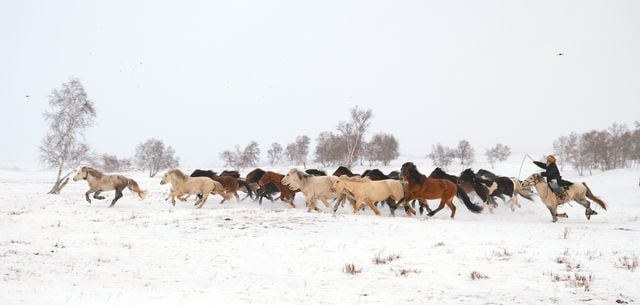
A good example of successful learning comes from Jessica, a learner who began studying Mongolian with a native tutor before taking part in the Mongol Derby, the long-distance horse race across the Mongolian steppe. Her goal was not vague or abstract. She needed personalized Mongolian lessons for a real journey: greeting people, asking practical questions, understanding simple answers, and communicating about horses, water, directions, food, and everyday needs.
That specific goal made her lessons more focused. Instead of learning random phrases from a general travel list, she could work on the language she was most likely to need in Mongolia. She also found that a tutor gave structure to what could easily have become a chaotic mix of apps, podcasts, music, phrasebooks, and browser tabs.
In her blog post, “Learning Mongolian for the Mongol Derby: First steps!”, Jessica explains that she was learning Mongolian specifically because of the race and because she needed language for real situations with horses, herders, travel, and basic communication.
Her early experience shows how quickly a real goal can shape the learning process. Jessica was not learning random textbook phrases. She needed practical Mongolian for questions such as where a horse is, whether a horse is ready, where to find water, where to sleep, and how to ask someone to repeat something more slowly.
As she writes near the beginning of the post:
“On the first day, I was hooked.”
That sentence captures the emotional side of language learning. Motivation becomes stronger when the language is connected to something personal, immediate, and meaningful.
Her second lesson shows this clearly. She learned phrases such as Морь хаана байна? [Where is the horse?], Энэ морь бэлэн үү? [Is this horse ready?], Ус хаана байна? [Where is water?], and Би хаана унтаж болох вэ? [Where can I sleep?]. These are not decorative phrases. They are language tools for a real journey.
This is where guided learning becomes especially useful. Independent resources can help with alphabet practice, music, podcasts, phrasebooks, and listening exposure. But a native-speaking tutor can correct pronunciation, explain cultural context, and build lessons around the situations the learner is most likely to face.
Jessica says this very directly when describing what happened after her first lesson:
“As soon as I said good-bye to Animaa that first day, I started looking for resources. There was no way that one lesson a week was going to be sufficient.”
That quote is especially useful because it shows how a tutor and independent study can work together. The lesson gives structure, correction, and direction. The resources between lessons help the learner stay exposed to the language.
For a Mongol Derby rider, that might mean phrases about horses, water, directions, food, rest, and everyday needs. For another learner, it might mean greetings, travel questions, family conversations, or business vocabulary. The lesson is the same: once your teacher understands why you want to learn Mongolian, your course can be personalised around the language you will actually use.
As Jessica puts it later in the article:
“Instead of simply memorizing vocabulary, they begin to understand the story behind the words, and that is often the moment when real learning begins.”
Learn Mongolian to Reach Your Goals
Jessica’s experience shows why guided learning matters. Independent resources can be useful, but they cannot tell you if your pronunciation is clear, if a phrase sounds natural, or if you are using language that fits the situation. A tutor can correct your mistakes, explain cultural context, and help you choose language that is useful for your own goal.
This is an important lesson for any learner: decide why you want to learn Mongolian before you begin. Your goal might be travel, work, family, study, heritage, research, or personal interest. Once your teacher knows that goal, lessons can be personalized around the words, grammar, and situations you are most likely to need.
For one learner, that might mean greetings, taxis, food, and hotel phrases. For another, it might mean workplace conversation, reading Cyrillic, or understanding Mongolian music and culture.
As Claire Stewart from New York, who took a 40-hour online Mongolian course with Arban, shared:
“My teacher was very knowledgeable about linguistics and the best ways to acquire language skills in a short amount of time. My course experience was very positive. The process was easy and I feel like what I learned helped me feel comfortable when I arrived in Mongolia!”
Claire’s words reinforce the value of learning with a clear purpose and the right support: when lessons are built around your real needs, even a challenging language like Mongolian can become practical, memorable, and useful before you arrive.
Do you want to take your learning experience to the next level? Contact Language Trainers and ask about online or face-to-face Mongolian lessons with a native-speaking teacher. Whether you are learning for travel, work, culture, heritage, or a specific personal goal, we can help you build a personalised course that gives your study routine structure, direction, and real conversational practice.
Mongolian may be challenging at first, but with the right support, it becomes much more approachable. Start with the essentials, practise consistently, and let every new phrase bring you a little closer to understanding the language, the people, and the culture behind it.
→Sign Up Now: Free Trial Mongolian Lesson With a Native Teacher!←
FAQs About the Mongolian Language
1. Is Mongolian hard to learn?
Mongolian can be challenging for English speakers because it uses vowel harmony, many suffixes, and a different word order from English. The good news is that these patterns are quite logical once you learn how they work, so steady practice is more useful than trying to memorise everything at once.
2. Is Mongolian written in Cyrillic or traditional script?
In Mongolia, Mongolian is mainly written in Cyrillic, so most beginners start there. Traditional vertical Mongolian script is also important, especially for culture, history, and Inner Mongolia, and learners may choose to study it later.
3. Is Mongolian similar to Russian or Chinese?
No. Mongolian belongs to the Mongolic language family, while Russian and Chinese come from different language families. Mongolian uses Cyrillic in Mongolia and has borrowed some words from neighbouring languages, but its grammar, pronunciation, and sentence structure are distinct.
4. What is the best way to learn Mongolian?
The best approach is to combine structured lessons with regular listening, vocabulary review, and speaking practice. A native-speaking teacher can be especially helpful because they can correct pronunciation, explain suffixes clearly, and show you which phrases sound natural in real situations.