


The best way to start learning Navajo is to begin with its sounds, learn a small amount of useful vocabulary in context, and gradually become familiar with the way Navajo sentences and verbs are built. You do not need to understand the language’s full grammar system before you start speaking and listening; for a beginner, getting comfortable with pronunciation and recurring patterns is a much better first goal.
Navajo, called Diné bizaad by its speakers, is a Native American language spoken primarily in the Southwestern United States. It belongs to the Southern Athabaskan branch of the Na-Dené language family, which means its structure is very different from English and from European languages such as Spanish or French.
That difference can make Navajo look intimidating when you first encounter it. You may see unfamiliar letters, accent marks, long words and verb forms that seem to contain far more information than an English verb would. As a beginner, however, you do not need to tackle all of that at once.
A sensible first stage is to learn how written Navajo sounds, listen carefully to fluent speakers, and practice common words and short expressions as complete units. Once those begin to feel familiar, you can start noticing how sentences are organized and how Navajo verbs change. Northern Arizona University’s Navajo Language Guide similarly brings together learning resources for people studying the language, reflecting the importance of combining reference material with continued exposure and practice.
→Sign Up Now: Free Trial Navajo Lesson With a Native Teacher!←
What Should You Know About the Navajo Language Before You Start?
Before you begin memorizing vocabulary, it helps to understand what kind of language you are learning. Navajo is not simply English with different words. Its sounds, sentence structure and especially its verb system work according to their own patterns.
One of the first differences you will eventually notice is word order. Navajo generally follows a subject–object–verb pattern, whereas English usually follows subject–verb–object. A sentence that corresponds roughly to “the boy sees the dog”, for example, would therefore tend to organize those elements more like “the boy the dog sees”. Navajo word order is more flexible than that simple formula suggests, but knowing this basic pattern gives beginners an early sense of why Navajo sentences may not line up neatly with English ones.
Verbs are even more important. A Navajo verb can carry information that English would often express through several separate words. Prefixes and other elements can indicate such things as who is performing an action, who or what is affected, and how the action unfolds. This is one reason Navajo grammar can look complicated in a reference book.
But that is something to grow into. If you are just starting, it is usually more useful to learn complete words and expressions, listen to how they are pronounced and notice recurring patterns than to try to memorize the entire verb system immediately.
There is also plenty that is approachable from day one. Navajo uses a Latin-based writing system, so you will recognize many of its letters. The main task is learning that some familiar-looking letters and marks represent sounds or distinctions that English does not use in the same way.
What Is Navajo Called in Navajo?
In Navajo, the language is commonly called Diné bizaad, meaning roughly “the People’s language.” The Navajo people refer to themselves as Diné, or “the People”. Another name for the language found in Navajo is Naabeehó bizaad.
This is useful vocabulary to learn early because you are likely to encounter Diné and Diné bizaad frequently in Navajo learning materials, educational programs and resources produced within the Navajo community.
The English word Navajo has a different history. It is an exonym—a name originating outside the community—and ultimately derives from a Tewa word that passed through Spanish before entering English. Diné bizaad, by contrast, is a name used from within the language itself.
For a learner, you do not need to choose one term and avoid the other. Navajo remains the standard English-language name, while learning Diné bizaad gives you one of your first meaningful pieces of vocabulary in the language you are studying.
Where Is Navajo Spoken?
Navajo is spoken primarily in the Southwestern United States, particularly in and around the Navajo Nation. The language is strongly associated with Arizona, New Mexico and Utah, while Navajo speakers also live elsewhere in the United States.
The Navajo Nation itself extends across parts of Arizona, New Mexico and Utah, so the language is not tied to a single state or city. Navajo also has an established presence in education and community life within the Nation, where language-teaching and immersion initiatives have formed part of broader efforts to maintain and strengthen its use.
For beginners learning from outside this region, this matters because listening should be part of your learning from the beginning. Navajo is not just something to study from grammar tables or written vocabulary lists. Hearing speakers use Diné bizaad will help you become familiar with distinctions in tone, vowel length and pronunciation that the spelling system represents but that may initially be difficult for an English speaker to interpret from the page alone.
Start with the Navajo Alphabet and Pronunciation
If you are learning Navajo from scratch, pronunciation is one of the best places to begin. Navajo uses a Latin-based alphabet, so many of the letters will look familiar to an English speaker, but they do not always represent the same sounds they do in English. You will also see apostrophes, accent marks and small hooks under vowels, all of which carry useful pronunciation information.
This can make written Navajo look complicated at first. In practice, the spelling system is quite helpful once you understand what the symbols mean. Rather than asking you to guess how a word sounds, Navajo spelling can tell you whether a vowel is long or short, whether it is nasal, whether it has a high tone, and whether a consonant is pronounced in a particular way.
You do not need to memorize every sound before learning vocabulary. A better approach is to become familiar with the most important differences from English, then keep returning to them as you encounter new words.
Which Navajo Sounds Are Different from English?
Navajo has several consonants that English does not use, as well as some familiar-looking letters that are pronounced differently. Linguists often describe these sounds with terms such as voiced, voiceless, lateral, aspirated and ejective. Those labels are useful, but they make much more sense when you know what they actually describe.
Voiced means that your vocal cords vibrate while you make a sound. Put your fingers lightly on your throat and say z. You should feel a vibration. Now say s. The mouth position is similar, but the vibration disappears. S is therefore voiceless, while z is voiced.
Lateral means that air escapes around the sides of the tongue rather than directly down the center of the mouth. English l is a lateral sound: your tongue touches the area behind your upper teeth while air passes around it.
Aspirated means that a noticeable puff of air follows the consonant. Hold your hand in front of your mouth and say the k in kite. You should feel the air. Navajo distinguishes aspirated consonants from consonants produced with much less of that puff.
Ejective consonants are different again. They are produced with a short build-up of pressure in the throat, creating a sharper, more abrupt release. Navajo spelling normally shows these sounds with an apostrophe, as in kʼ, tʼ, tsʼ and chʼ. You do not need to understand the mechanics perfectly on your first day. What matters initially is recognizing that the apostrophe changes the pronunciation and should not simply be ignored.
Here are some of the Navajo sounds worth learning early.
ł — /ɬ/
The letter ł represents what linguists call a voiceless lateral fricative. That sounds much more intimidating than it is.
“Voiceless” means your vocal cords do not vibrate. “Lateral” means the air passes along the sides of your tongue. “Fricative” simply means that the air is pushed through a narrow space, creating friction.
To try it, put your tongue in roughly the same position you would use for an English l, but instead of voicing the sound, blow air around the sides of your tongue. The result is a soft, breathy sound rather than an ordinary l.
You can see ł in łį́į́ʼ, meaning horse. Wiktionary compares the sound with Welsh ll, as in llwyd.
ʼ — /ʔ/
The standalone apostrophe represents a glottal stop. A glottal stop is a very brief closure in the throat that interrupts the airflow.
English speakers already make this sound, even if they do not think of it as a consonant. Say uh-oh slowly. The tiny break between uh and oh is a glottal stop.
In Navajo, that sound is part of the language itself and is represented in writing when it occurs after a vowel. Navajo words that begin with a vowel are also pronounced with an initial glottal stop, although that initial one is normally not written.
You will encounter it in very common words such as yáʼátʼééh, a familiar Navajo greeting. The apostrophes are not punctuation marks separating parts of the word. They represent sounds that need to be pronounced.
kʼ — /kʼ/
Navajo kʼ is an ejective k. Start from the place in your mouth where you would produce an English k, but instead of releasing it with the ordinary puff of air, the sound has a tighter, sharper release created with pressure from the throat.
An example is kʼad, meaning now.
It is useful to compare kʼ with plain k. Navajo k is aspirated, so it comes with a puff of air similar to the k in English kite. The apostrophe in kʼ tells you to produce a different consonant, not simply a stylistic variation of the same sound.
tʼ — /tʼ/
The same principle applies to tʼ, an ejective t sound. Your tongue begins in roughly the place it would for t, but the consonant is released more sharply using pressure in the throat.
You can see it in tʼáá, a very common Navajo element whose meaning depends on context and can correspond to ideas such as only or just.
At first, you do not need to produce the ejective sound perfectly. Focus on hearing that t and tʼ are different and on keeping the apostrophe when you write the word.
chʼ — /tʃʼ/
Chʼ is the ejective counterpart of ch. Navajo ch is similar to the ch in English chin, while chʼ has the same general mouth position but a sharper ejective release.
One example is chʼosh, meaning bug or worm.
tsʼ — /tsʼ/
The combination ts may already feel fairly familiar because English uses the sequence in words such as cats. Navajo also has tsʼ, where the apostrophe tells you that the sound is ejective.
An example is tsʼah, meaning sagebrush.
Again, the important beginner lesson is that ts and tsʼ represent different sounds. It is worth learning the apostrophe as part of the word rather than treating it as something optional.
tł and tłʼ
Navajo also combines t with the lateral sound represented by ł.
Tł begins with a t-like closure and releases into that breathy ł sound. Tłʼ is the ejective version, so it has the additional sharp release from the throat.
You can see tłʼ in tłʼízí, meaning goat. These combinations may take some practice because English does not have a direct equivalent.
gh — /ɣ/
The spelling gh represents another sound that standard English does not normally use. Linguists call it a voiced velar fricative.
“Velar” means the sound is made toward the back of the mouth, near the soft part of the roof of the mouth. “Fricative” means the air passes through a narrow opening rather than being completely stopped. “Voiced” means your vocal cords vibrate.
One way to approach it is to think of the ch sound in the Scottish pronunciation of loch, but add vibration in your throat. Wiktionary uses the same comparison.
Navajo spelling has an additional complication here: related versions of this sound may be written y before i and e, w before o, and gh before a. That is something you can gradually learn through vocabulary rather than trying to memorize as an abstract rule on day one.
b, d and g
Some of the most surprising Navajo sounds are represented by letters you already know.
Navajo b is closer to the p in English spade than to the b in boy. Navajo d is comparable to the t in stop, and g to the k in skin. These consonants are described as unaspirated, which means they are pronounced without the strong puff of air heard in consonants such as the k in kite.
Try saying kite and skin with your hand in front of your mouth. The k in kite produces a much stronger puff of air. That simple comparison gives you a good sense of what linguists mean by aspirated and unaspirated.
Navajo also includes combinations such as dl, dz, hw, kw, sh, ts and zh. Some are relatively easy for English speakers to approximate, while others will require more listening practice. Sh, for example, resembles the sound in English ship, while zh resembles the middle sound in measure.
The goal is not to memorize an IPA chart before continuing with the language. Learn what the symbols mean, listen to them in real words, and keep returning to the sounds that are difficult for you.
Why Do Navajo Vowels Have Different Marks?
Navajo vowels deserve just as much attention as the consonants. The language has four basic vowel qualities, written a, e, i and o, but those vowels can change according to three important features: length, nasality and tone.
Those three terms are easier than they may sound.
Length simply refers to how long you hold the vowel.
A short vowel is written once:
a, e, i, o
A long vowel is written twice:
aa, ee, ii, oo
So aa is not merely an alternative spelling of a. It tells you to keep the vowel going for longer. Navajo uses vowel length to distinguish sounds, which means it is something learners need to hear and reproduce rather than ignore.
You can see a long vowel in bizaad, the word for language in Diné bizaad. The aa is deliberately doubled.
Nasality refers to where the air goes when you pronounce the vowel.
For an ordinary oral vowel, most of the air leaves through your mouth. For a nasal vowel, some of the air also passes through your nose.
English speakers already produce some degree of nasalization naturally, especially around consonants such as m and n, but Navajo treats oral and nasal vowels as distinct parts of its sound system.
Nasal vowels are written with a small hook underneath them, called an ogonek:
ą, ę, į, ǫ
The name ogonek is not something you need to memorize. The practical rule is much simpler: when you see the hook underneath a Navajo vowel, the vowel is nasal.
You can see this in łį́į́ʼ [horse]. Both vowels contain the hook, so they are nasal.
Tone refers to the pitch of your voice.
Navajo distinguishes between high and low tone. High tone is shown with an acute accent:
á, é, í, ó
Low tone is normally left unmarked:
a, e, i, o
This is not the same as English word stress. In English, we may pronounce one syllable more strongly than another, as in PREsent versus preSENT. Tone is about the pitch of the vowel itself: whether your voice is relatively higher or lower while you pronounce it.
You can see high tone in Diné. The final é carries an acute accent, which tells you that the vowel has high tone.
These features can also occur together. A vowel can be long and high, nasal and high, or long, nasal and high.
For example:
á = short vowel with high tone
aa = long vowel
ą = nasal vowel
ą́ = nasal vowel with high tone
áá = long vowel with high tone
į́į́ = long, nasal vowel with high tone
Navajo long vowels can also change tone while you pronounce them. Because a long vowel is written with two vowel letters, each half can carry its own tone marking. Forms such as aá and áa therefore indicate a movement in pitch across the long vowel rather than a single flat tone.
At first, all those marks can make a Navajo word feel visually busy. łį́į́ʼ is a good example. But once you know what each symbol does, you can actually read quite a lot of pronunciation information from the spelling:
ł tells you to use the voiceless lateral sound.
į́į́ tells you that the vowel is long, nasal and high-toned.
ʼ tells you that the word ends with a glottal stop.
You are not expected to analyze every new word this consciously forever. The point of learning these features early is to understand what you are seeing and, more importantly, what you should listen for.
When you learn a new Navajo word, keep its full spelling. Do not remove the accent marks, hooks or apostrophes because they look inconvenient. Listen to the word while looking at it, repeat it several times, and try to connect each unfamiliar symbol with the sound you hear. Over time, ł, ą, á, kʼ and the other features stop looking like special notation and simply become part of reading Navajo.
Learn Navajo Words by Listening as Well as Reading
When you start building vocabulary in Navajo, do not learn words only from the page. Because Navajo distinguishes features such as tone, vowel length, nasalization and glottal stops, the written form gives you important clues, but you still need to hear how those clues come together in real speech.
This is especially important because English speakers are used to treating things like pitch or vowel length as relatively minor pronunciation details. In Navajo, they are part of the sound system itself. If you learn a word with the wrong tone or ignore a glottal stop, you may end up practicing a pronunciation that is difficult to correct later.
A good beginner habit is to treat every new word as having three parts:
- The spelling – including accents, hooks and apostrophes.
- The sound – ideally from a fluent or native speaker.
- The meaning in context – not just an isolated English translation.
Take Diné, for example. You should learn not only that it refers to “the People”, but also notice the high tone on the final é and hear how the whole word is pronounced naturally. The same applies to chidí [car], ashkii [boy] and atʼééd [girl]. The marks in those words are not optional decoration; they form part of the spelling and pronunciation.
This also means that copying Navajo words into your notes without their accents or apostrophes is not a good shortcut. It may make the word look easier, but it removes information you actually need.
When you learn a new word, try a simple routine: listen to it several times, look at the spelling while you listen, repeat it slowly, and then say it again without the recording. After that, use it in a short phrase or sentence if you can.
That last step matters because Navajo words often change or combine with other grammatical elements in ways that English words do not. The language makes extensive use of prefixes and other affixes, particularly in verbs, so learning vocabulary in complete examples will prepare you for grammar without requiring you to study every rule first.
What Vocabulary Should Navajo Beginners Learn First?
A beginner does not need hundreds of disconnected nouns. It is much more useful to build a small core vocabulary that helps you recognize people, objects and actions and begin understanding simple sentences.
A useful starting point is to organize your first vocabulary into several broad groups.
People and everyday nouns give you concrete words that are easy to recognize and reuse. Some examples found in basic Navajo sentence examples include:
- ashkii – boy
- atʼééd – girl
- béégashii – cow
- bilasáana – apple
- chidí – car
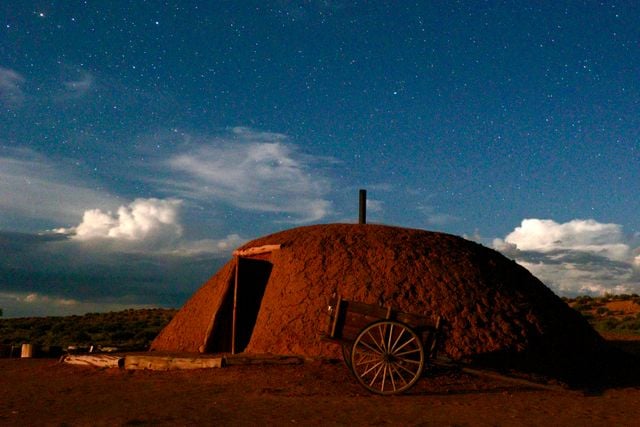
- hooghan – hogan, a traditional Navajo dwelling
These are useful not because you urgently need to talk about cows and apples, but because simple nouns make it easier to see what the rest of a sentence is doing.
For example:
Atʼééd ashkii yiyiiłtsą́.
The girl saw the boy.
Here you can already identify atʼééd [girl] and ashkii [boy]. That leaves the verb yiyiiłtsą́, meaning roughly [he/she saw him/her], as the new part to investigate.
Family vocabulary is also useful early on, particularly because Navajo possession often appears directly on the noun. Rather than thinking only in terms of separate English-style words such as my + car, notice how a possessive prefix can attach to the Navajo noun. The basic noun chidí means [car], while shichidí means [my car].
That small example teaches you vocabulary and grammar at the same time: shi- can express a first-person relationship in this context.
You should also begin collecting frequent actions, because verbs are so central to Navajo. Useful early meanings include things like:
- go / come
- eat
- drink
- see
- give
- sit or lie
- speak
- work
The exact form of a Navajo verb matters more than a simple English-style dictionary label. For example, yishą́ means [I am eating something], yishááh means [I am going/coming], and yishdlį́į́h means [I usually drink something]. Learning these complete forms helps you see how Navajo verbs work in real sentences, rather than treating them as direct equivalents of English words such as eat, go and drink. This is an important change of mindset. In English, beginners are often comfortable memorizing:
eat = X
drink = Y
go = Z
Navajo does not always reward that approach. A verb form can contain information about who is doing the action, who or what is affected, and how the action is taking place.
So instead of trying to collect a huge list of “Navajo words”, build small sets of words plus examples.
For instance:
bilasáana – apple
Bilasáana shaa niʼaah. – You give me an apple.
Now you have learned a noun, seen where it appears in a sentence, and encountered a complete form of the verb “give”.
Numbers and basic descriptions are also worth introducing early, but the same rule applies: learn them in phrases rather than as isolated flashcards whenever possible. A number becomes more memorable when it appears with a noun; a description becomes more useful when it appears in a complete statement.
The goal at this stage is not to know “the 500 most common Navajo words”. It is to build a small vocabulary that lets you start recognizing patterns.
Learn Simple Navajo Sentence Patterns
Once you have a handful of words, you can start looking at how Navajo puts them together. One of the first differences English speakers notice is that Navajo commonly follows subject–object–verb order. English, by contrast, usually follows subject–verb–object order.
Take this Navajo example:
Atʼééd ashkii yiyiiłtsą́.
Literally, the order is approximately:
girl – boy – saw
The natural English translation is:
The girl saw the boy.
So where English puts saw between the two people, Navajo places the verb at the end.
If we reverse the nouns:
Ashkii atʼééd yiyiiłtsą́.
we get:
The boy saw the girl.
That gives a beginner a useful first pattern:
WHO DOES IT + WHO/WHAT IT AFFECTS + VERB
You should not treat that formula as an absolute rule, though. Navajo word order is flexible and can change according to context and what the speaker wants to emphasize. For now, it is enough to know that subject–object–verb is a useful basic pattern to expect, rather than trying to force every Navajo sentence into English order.
Another beginner-friendly example is:
Bilasáana shaa niʼaah.
bilasáana = apple
shaa = to me
niʼaah = you give it
Together:
You give me an apple.
What is interesting here is that English needs several separate elements to express the idea clearly, while the Navajo verb itself already carries information about the participants in the action.
This is why literal word-for-word translation can become confusing very quickly. Your goal should be to understand how a Navajo sentence expresses the idea as a whole, not to make every Navajo element line up neatly with one English word.
Why Are Navajo Verbs So Important for Beginner Learners?
If there is one grammatical idea a Navajo beginner should understand early, it is this: verbs do a great deal of work.
In English, we often spread grammatical information across several separate words:
I am going.
I went.
I will go.
I usually go.
Navajo often expresses differences like these through changes inside the verb itself. Verbs can include prefixes that indicate the person and number of the subject or object, while changes in mode and aspect tell us how the action unfolds.
Consider several forms connected with going:
yishááh – I am going/coming
yíyáʼ – I went/came/arrived
deeshááł – I will go/come
yishááh – I usually go, in the appropriate usitative interpretation/context
You do not need to analyze every letter yet. What matters is noticing that Navajo does not simply take one unchanged word meaning “go” and place separate words around it.
The verb can change internally according to meaning.
Navajo verbs can also tell us something about who performs an action. A useful example is the imperfective verb meaning “freeze”:
yishtin – I freeze
nitin – you freeze
yitin – he/she/it/they freeze
yiitin – we freeze
Notice again that Navajo does not necessarily require separate pronouns equivalent to English I, you, he or we. Information about the person can already be built into the verb.
In fact, a Navajo sentence does not always require a separate noun at all because the verb can carry so much grammatical information.
Verbs can become even more specific. Some Navajo verb roots used for handling or positioning objects vary according to characteristics such as the shape or number of the object involved. The grammar sources give different forms of “give”, for example, depending on whether the object is a single solid roundish object or a plural object.
Compare:
Bilasáana shaa niʼaah.
You give me an apple.
and:
Bilasáana shaa ninííł.
You give me apples.
The English verb remains give. Navajo changes the verb form according to the object involved.
That does not mean a beginner needs to memorize every possible verb variation immediately. It means you should avoid learning verbs as though they were simple one-word substitutions for English verbs.
Instead of looking for a single Navajo word that always means give, learn complete examples such as:
Bilasáana shaa niʼaah. – You give me an apple.
Now you have a complete pattern that you can return to later when you begin studying how the verb itself is constructed.
Don’t Try to Learn All Navajo Grammar at Once
If you open a detailed Navajo grammar as a complete beginner, the verb sections can look overwhelming. You may encounter terms such as imperfective, perfective, progressive, usitative, iterative, optative, aspect, classifier and stem before you have enough vocabulary to hold a basic exchange.
Those concepts are real and useful, but you do not need to master them all before you can begin learning Navajo.
A good example is the distinction between mode and aspect.
Very simply, these systems help describe how an action happens, rather than merely when it happens.
Navajo grammar distinguishes several verb modes. The imperfective, for example, can describe an action that is incomplete, while the perfective often describes an action viewed as complete. There are also forms associated with ongoing actions, future actions, habitual actions, repeated actions and wishes or possibilities.
Compare:
yishą́ – I am eating something
with:
yíyą́ą́ʼ – I ate something.
For a beginner, that contrast is already useful. You can see that the form of the verb changes when the speaker views the action differently.
You do not need to follow that immediately with a chart of every prefix position and every possible aspect.
The same applies to habitual actions. The grammar gives yishdlį́į́h for [I always/usually drink something] and an iterative form náshdlį́į́h in an example meaning [I drink coffee when I get up]. The added material in the verb helps express repetition or customary action.
At beginner level, the useful lesson is:
Navajo verbs change according to more than past, present and future.
That idea prepares you for later grammar without asking you to memorize the entire system.
A sensible progression is to learn one form you can use, then gradually compare it with related forms.
For example:
First learn yishááh [I am going/coming].
Later add deeshááł [I will go/come].
Later still look at yíyáʼ [I went/came/arrived].
Only once those forms are familiar does it become particularly useful to ask why they differ and start learning about modes, stems and prefixes.
This approach also keeps grammar connected to meaning. Instead of memorizing “the perfective mode” as a definition, you see it operating in a form you already recognize.
The same principle works with sentence structure. Begin by noticing:
Atʼééd ashkii yiyiiłtsą́.
The girl saw the boy.
Then recognize that the verb comes at the end.
Later, notice that yiyiiłtsą́ contains information about both the person who sees and the person who is seen.
Only after that do you need to investigate the individual prefixes in detail.
For most beginners, this order is far more manageable:
hear the form → understand what it means → use it in context → notice a pattern → learn the grammatical explanation
Grammar is still important. You are simply giving yourself enough language first so that the explanations have something concrete to attach to.
Use Reliable Navajo Learning Resources
When you are learning Navajo independently, it helps to use several types of resources rather than relying on a single app, dictionary or grammar guide. A good beginner routine should include material for reading, vocabulary, pronunciation and listening, so that you keep connecting written Navajo with the way the language actually sounds.
A useful place to begin is the University of New Mexico’s Navajo Language Program learning materials. Its resource page brings together beginner reading practice, searchable dictionaries and grammar tools, videos, games and other study materials in one place. It also links to Navajo children’s books, which can be particularly useful for beginners because they provide relatively accessible reading practice without requiring you to work through advanced grammatical explanations first.
The same page points learners towards resources for different skills, which is a good model for organizing your own study. You might spend one session reading a short text, another reviewing vocabulary, and another listening to spoken Navajo. This gives you repeated contact with the language without making every study session feel like a grammar lesson.
For a broader collection of materials, Navajo Now is worth exploring. The site gathers links to audio and visual material, reading resources, vocabulary tools and information about Navajo language-learning opportunities. It also includes posts about the practical side of learning, such as finding tutors and working with fluent speakers.
One particularly useful piece of advice from Navajo Now is to keep early practice manageable: work with short phrases, listen carefully and repeat frequently rather than trying to tackle complex language immediately. That fits especially well with the approach we have followed throughout this guide. At beginner level, repetition becomes much more useful when you are repeatedly hearing and producing complete pieces of real Navajo rather than memorizing long lists of isolated translations.
If you want to expand your vocabulary gradually, Navajo Word of the Day offers another useful option. Despite the name, the entries often go beyond simply presenting a Navajo word and an English equivalent. They can include audio, explanations of how a word is formed, and cultural or historical context that helps explain how it is actually used.
For example, an entry on Tsé Bit’a’í, the Navajo name for Shiprock, breaks the expression into its component meanings and explains how those elements contribute to the overall idea of a “rock that has wings”. This kind of explanation can be much more helpful than memorizing a translation alone because it begins to show you how meaning is constructed within Navajo words and expressions.
Audio is particularly valuable here. When you encounter a new word, try not to read the English translation and move straight on. Play the recording, look carefully at the Navajo spelling, listen again, and then repeat the word aloud. Pay attention to the features we discussed earlier: long vowels, tone, nasal vowels, glottal stops and unfamiliar consonants.
You can add longer listening practice with the University of New Mexico’s UNM Navajo Language Program YouTube channel. UNM includes the channel among its recommended video resources and describes it as containing Navajo vocabulary and cultural content.
Do not worry if you cannot understand an entire video. As a beginner, listening has another purpose: training your ear. You can listen for a word you have recently learned, notice where one phrase seems to end and another begins, or focus on recognizing sounds such as ł and the glottal stop. Understanding a little more each time is already useful practice.
The important thing is not to collect dozens of resources and then try to use all of them every day. Choose a small combination that covers different skills. You might use the UNM resource collection to find structured study material, Navajo Word of the Day to add vocabulary, Navajo Now when you want additional learning ideas and materials, and the UNM YouTube channel for regular listening practice.
For a complete beginner, that is much more sustainable than searching for one resource that promises to teach you everything. Navajo involves sounds and grammatical patterns that become clearer through repeated exposure, so the strongest resources are the ones you will actually return to and use consistently.
Learn Navajo with a Teacher Through 1-1 Lessons
Independent study can take you a long way with Navajo, but some parts of the language are much easier to learn when a teacher can hear you and respond in real time. This is particularly useful for tone, vowel length, glottal stops and unfamiliar consonants, where understanding the rule does not always mean you are producing the sound correctly.
A teacher can model a sound, listen to your attempt and show you what to adjust before inaccurate pronunciation becomes a habit. The same support helps with Navajo verbs, which can change according to who performs an action, who or what is affected, and how the action is viewed.
This is one of the main advantages of one-to-one learning. Instead of following a fixed syllabus for a whole group, the teacher can spend more time on the areas you personally find difficult and move more quickly through those that come naturally.
At Language Trainers, we place particular value on face-to-face, one-to-one Navajo lessons. Learning in person makes it easier to observe pronunciation closely, hear subtle sound differences and receive immediate feedback while you speak. It also creates more opportunities for spontaneous interaction, rather than limiting practice to prepared exercises.
Your course can also reflect why you want to learn Navajo. Someone learning for family or heritage reasons may prioritize everyday conversation, while another learner may need Navajo for study, work or a personal interest in Diné bizaad.
That personal focus is what makes one-to-one lessons especially useful for beginners. You can build the language step by step, concentrating on the vocabulary, pronunciation and grammar you actually need rather than trying to learn everything at once.
Whether you want to take Navajo lessons in Phoenix, Albuquerque, Denver, or another city near you, or prefer to learn through live online lessons from home, we can arrange a one-to-one course around your level, goals and schedule. Contact Language Trainers today and tell us what you want to achieve with Navajo so we can match you with the right teacher and build a course around you.
→Sign Up Now: Free Trial Navajo Lesson With a Native Teacher!←
Frequently Asked Questions About Learning Navajo
-
How Difficult Is Navajo to Learn for English Speakers?
Navajo is challenging for English speakers because its sound system and grammar work very differently from English. Learners need to become comfortable with tone, vowel length, nasal vowels, glottal stops, ejective consonants, and a highly complex verb system. Navajo verbs can also express information about who is acting, who or what is affected, and how an action unfolds. The language becomes much more manageable when these features are introduced gradually through real words and complete sentences rather than memorized as abstract rules.
-
How Long Does It Take to Learn Navajo?
There is no single reliable number of hours for learning Navajo because progress depends heavily on your goals, study frequency, access to fluent speakers, and how much listening and speaking practice you get. A beginner can learn pronunciation rules, greetings, common vocabulary, and simple sentence patterns relatively early, but comfortable conversation takes much longer because Navajo verbs and sound distinctions require repeated exposure. Regular practice with audio and a teacher or fluent speaker can make a major difference.
-
Can I Learn Navajo Online?
Yes. Navajo can be learned online through a combination of structured lessons, dictionaries, reading materials, audio resources, videos, and live speaking practice. Online learning is especially useful for people who do not live near Navajo-speaking communities, but it should include regular listening and pronunciation feedback, not just written exercises. Because distinctions such as tone, vowel length, and glottal stops matter in Navajo, live interaction with a Navajo teacher can help prevent pronunciation mistakes from becoming habits.
-
What Should I Learn First in Navajo?
Start with pronunciation and a small set of useful words and sentence patterns rather than trying to master Navajo grammar immediately. Learn how symbols such as ł, ʼ, á, ą, kʼ, and tʼ affect pronunciation, then practice common words while listening to fluent speech. From there, begin learning complete verb forms and simple subject–object–verb sentences. This approach lets you build vocabulary and grammar together while getting used to the sound system from the beginning.