
Shopping in Brazil: The Language, Etiquette, and Social Rituals Behind Everyday Transactions
 Posted by
 Shopping in Brazil is not just about knowing how to ask for a price or pay for a product. Shopping in Brazil often involves a whole set of social habits that shape how people greet each other, how they open a conversation, how they ask for help, and even how they negotiate. In many situations, especially in bakeries, street stalls, neighborhood shops, open-air markets, and beach kiosks, the interaction begins long before money is mentioned. A greeting, a short comment, a joke, or a warm expression may come first. For many learners, that is surprising at the beginning, especially if they come from places where shopping feels more direct, faster, and more purely transactional.
That is why language alone is not enough here. To shop comfortably in Brazil, you need to understand a few basic cultural patterns too. You need to know that informality often signals friendliness, not disrespect. You need to know that a vendor may speak warmly to you within seconds, using expressions that sound very personal in translation but feel completely normal in context. You need to know that bargaining may be expected in some places and unusual in others. You need to know that tone, rhythm, and small talk often shape the success of the interaction just as much as the words themselves.
In this article, I will explain how Brazilians actually communicate when shopping, from greetings and common Portuguese phrases to bargaining, politeness strategies, street market language, and the social logic behind everyday transactions. My goal is not only to give you useful Brazilian Portuguese shopping phrases, but to help you understand the culture behind them so that shopping in Brazil feels more natural, more enjoyable, and much less confusing.
→Sign Up Now: Free Trial Portuguese Lesson With a Native Teacher!←
Why Shopping in Brazil Is More Than Just Buying Something
In Brazil, shopping is often a small social performance. Of course, you are there to buy something, but in many contexts you are expected to do a little more than that. You greet the person. You make eye contact. You exchange a few words. Sometimes you comment on the product. Sometimes the vendor comments on you. Sometimes there is a little humour before the real transaction even starts. Skipping all of that and going straight to the point may sound efficient in some cultures, but in Brazil it often feels cold.
I noticed that very clearly when I lived for a few years in Joinville, in the state of Santa Catarina. Near my home there was a bakery called Dona Gostosura that I used to visit with family and friends. From the very first time I went there, the owners and the staff spoke to us in a warm, informal way that immediately changed the atmosphere. They would say things like E aí, patrão, beleza? Como vai a vida ultimamente? or “Hey boss, how are you? How’s life been lately?” After only a few visits, they were already asking O mesmo de sempre? or “The usual?” That kind of interaction says a lot about Brazil. Even a simple purchase can start turning into familiarity, and familiarity can slowly become friendship.
That is one reason I always tell my students that shopping in Brazil is relational, not purely commercial. People often expect a minimum of human connection before the exchange becomes fully transactional. This is where the idea of jeitinho brasileiro comes in. Jeitinho brasileiro (the Brazilian way) is not just about “finding a way” around problems. In everyday life, it often means navigating situations with flexibility, warmth, creativity, and a certain social intelligence. In shopping situations, that may appear as a softer tone, a light joke, a friendly request, or a more indirect way of asking for a discount or a favor. Understanding that mindset helps learners see that the language of shopping in Brazil is not only practical. The language of shopping in Brazil is deeply social too.
Why small talk matters in Brazilian shopping culture
Small talk matters in Brazilian shopping culture because it helps create the relationship that makes the transaction feel smooth and natural. In many shops, markets, and stalls, a simple Oi, tudo bem? (Hi, how are you?) or Bom dia, tudo certo? (Good morning, is everything all right?) is more than a greeting. It helps establish warmth and mutual respect before any question about price, size, or payment appears. That short exchange may look unimportant to an outsider, but socially it does real work.
I often explain to students that going straight to Quanto custa? (How much does it cost?) without any opening may sound too abrupt in Brazil, especially in smaller or more informal settings. A vendor might still answer politely, of course, but the interaction loses a layer of connection that Brazilians naturally expect. In a bakery, a neighborhood fruit stand, or a feira, that opening moment helps reduce distance. It tells the other person that you are not treating them like a machine. You are recognizing them as part of the interaction.
That is why even very short phrases carry a lot of value. A vendor might ask Posso ajudar? (Can I help?) A customer might respond with Tô só olhando (I’m just looking), which sounds softer than immediately refusing assistance. In many cases, a little small talk makes everything that comes after it feel easier, including questions, jokes, negotiation, and even refusal. In Brazil, that brief human connection is often part of the purchase itself.
How the Brazilian character shapes everyday transactions
Jeitinho brasileiro shapes everyday transactions because Brazilians often manage social situations with flexibility instead of rigid directness. In shopping contexts, that does not necessarily mean breaking rules or manipulating people, which is how the term is sometimes misunderstood. Very often, it means using charm, warmth, politeness, humour, and a bit of improvisation to make the interaction flow better.
You can hear that in the language people choose. Instead of asking for a lower price in a blunt way, someone might say Tem como fazer um precinho pra mim? (Is there any way you could give me a little special price?). The diminutive in precinho (little price / a slightly lower price) softens the request and makes it sound friendlier. Instead of demanding attention, a customer may begin with a compliment like Os produtos aqui parecem ser excelentes (The products here look excellent). That kind of phrasing is not random. It creates the atmosphere in which negotiation becomes socially acceptable.
I think this is one of the most fascinating things about shopping in Brazil. A transaction may involve practical goals, but those goals are often reached through social skill. A little humour, a relaxed tone, a more affectionate expression, or a flexible turn of phrase may change the whole interaction. For learners, understanding jeitinho brasileiro is useful because it explains why Brazilian commercial language often sounds warmer, less direct, and more relational than textbook dialogues usually suggest.
Brazilian Portuguese Shopping Phrases for Greeting and Starting a Conversation
One of the first things learners notice in Brazil is that shopping interactions usually begin with more warmth than they expect. In many places, especially bakeries, small shops, markets, and street stalls, people rarely jump straight into the transaction. There is usually a greeting first, often followed by a quick social exchange that helps set the tone. That opening matters because in Brazil, the way you begin often shapes how the rest of the interaction feels.
I always tell my students that learning Brazilian Portuguese shopping phrases is not just about memorizing useful lines. It is about understanding what those lines do socially. A phrase may open the interaction gently, show friendliness, reduce distance, or signal that you understand the rhythm of Brazilian conversation. That is why even simple expressions deserve attention. Below are some of the most useful phrases, but I want to go beyond translation and explain how they actually function in real life.
Common Brazilian Portuguese shopping phrases and the social meaning behind them
Oi, tudo bem? (Hi, how are you?)
This is one of the safest and most useful openings in Brazil. It works almost everywhere and sounds warm without being overly informal. In a shop, this phrase does more than greet the person. It shows that you are entering the interaction socially, not mechanically. I often recommend this phrase to students because it immediately softens the atmosphere.
Bom dia, tudo certo? (Good morning, is everything all right?)
This sounds slightly more local and conversational than a plain bom dia (good morning) on its own. The extra tudo certo? (everything all right?) adds warmth and makes the interaction feel less stiff. In Brazil, that little addition often matters. It helps you sound more engaged and less transactional.
Posso ajudar? (Can I help?)
This is one of the phrases you will hear most from sales assistants and vendors. The literal meaning is simple, but culturally it often comes quickly, sometimes almost as soon as you enter the shop. For learners from more reserved cultures, that immediate approach may feel intense at first. In Brazil, it usually signals attentiveness, not pressure.
Pois não? (Yes, how can I help?)
This phrase confuses many learners because it contains não (no), but the meaning is actually positive and helpful. In commercial settings, pois não? often means something like “yes?”, “certainly”, or “how can I help?” I always tell students not to translate it word by word. The important thing is to recognize it as a polite service formula. It is very common in shops and service interactions.
Tô só olhando (I’m just looking)
This is one of the most useful phrases for learners because it lets you respond politely without closing the interaction too abruptly. I prefer teaching tô só olhando instead of a more direct refusal because it sounds natural and relaxed in Brazil. Pronunciation matters here too. In real speech, estou becomes tô, which is one of the first reductions students should get used to hearing.
Estou procurando… (I’m looking for…)
This is useful when you already know what you want and want to guide the interaction politely. For example, Estou procurando uma camisa preta (I’m looking for a black shirt). I like this phrase because it sounds clear without sounding demanding. In Brazil, being clear is good, but sounding too abrupt too early may make the interaction feel colder than it needs to.
Quanto custa isso? (How much does this cost?)
This is very practical, especially when you do not know the word for the item. The word isso (this / this thing) is helpful because it lets you point and ask naturally. I often recommend this phrase to beginners because it reduces stress. You do not need perfect vocabulary to function well in a shop.
Quanto tá isso? (How much is this?)
This sounds more informal and closer to real spoken Brazilian Portuguese. The tá is the reduced spoken form of está (is). Students will hear this constantly in Brazil, especially in quick everyday exchanges. I always point this out because textbooks often teach the full form first, but real life usually gives you the shorter one.
Gostei (I liked it)
Brazilians often use the past tense when reacting to something in the moment. That surprises many learners. In English, people usually say “I like it.” In Brazil, gostei often sounds more natural in a shop after trying something or seeing a product. That is a small but very real cultural-linguistic detail that makes learners sound more natural very quickly.
Vou levar (I’ll take it)
This is one of the most common ways to say you want to buy something. The verb levar literally means “to take,” but in this context it means you are going to buy and take the item with you. I like teaching this phrase because it is short, natural, and extremely common. In real shopping situations, Brazilians use it all the time.
Tem menor? (Do you have a smaller one?) (Or “Tem maior? for Do you have a bigger one?)
These are very useful in clothing shops and markets. The key thing here is the comparative form. Many learners want to say mais pequeno or mais grande, but in real Brazilian Portuguese, menor (smaller) and maior (bigger) sound much more natural in this context. These are exactly the kinds of details that make a learner sound more socially and linguistically comfortable.
Tem em outra cor? (Do you have it in another colour?)
This is practical, polite, and easy to adapt. It works especially well in stores where the interaction is slightly more structured. I like it because it sounds natural without needing complex grammar, and it helps the learner keep the interaction flowing instead of stopping after one answer.
É no débito ou no crédito? (Is it debit or credit?)
This is another phrase learners hear constantly at the cashier. In Brazil, many bank cards function in both modes, so this question is extremely common. I always tell students to train their ears for the rhythm of this phrase because cashiers often say it quickly. Even advanced students sometimes understand all the words separately but miss the phrase when it comes fast in real life.
Vai parcelar? (Are you going to pay in installments?)
This is a very Brazilian shopping phrase because installment payments are such a normal part of everyday commercial life in Brazil. From a cultural point of view, this phrase teaches more than vocabulary. It reveals a payment culture that surprises many foreigners. Understanding parcelar (to pay in installments) helps learners make much more sense of how shopping works in Brazil, especially in larger stores.
É pra presente? (Is it a gift?)
This is another common cashier phrase. In fast speech, para becomes pra, and students should get used to hearing that reduction because it appears everywhere in Brazilian Portuguese. It is one of those small pronunciation realities that textbooks often present later, but real interactions give you immediately.
What I always tell my students is that these phrases work best when they are not delivered like lines from a script. In Brazil, the tone behind the phrase matters almost as much as the phrase itself. A greeting with eye contact and a relaxed voice sounds much better than perfect grammar spoken too stiffly. That is why I encourage students to practice these expressions aloud, not just memorize them silently. Brazilian Portuguese shopping language lives in rhythm, tone, and human interaction.
How to Haggle in Brazil with Confidence
Knowing how to haggle in Brazil is not just about asking for a lower price. Knowing how to haggle in Brazil means understanding when negotiation feels natural, how Brazilians soften requests, and how tone changes everything. In the right setting, bargaining is expected. In the wrong one, it feels awkward or out of place.
When bargaining is appropriate in Brazil and when it is not
In Brazil, the verb pechinchar (to haggle / to bargain) describes the act of negotiating a better price, usually in a friendly and informal way. Pechinchar is a normal part of commercial life in many open-air settings. At a feira (street market / open-air market), with a beach vendor, at a camelô (street stall vendor), or in smaller informal selling environments, asking for a discount often feels completely natural. In those places, price is not always treated as something fixed and untouchable. Price may be part of the conversation.
In more formal settings, though, the rules change. In shopping malls, chain stores, supermarkets, and larger retail spaces, direct bargaining is much less common. In those places, people usually accept the listed price unless there is already a promotion or unless the discussion shifts to payment conditions. One exception is paying à vista (in one single payment / all at once), especially for a more expensive item. In Brazil, paying à vista or paying in cash may open the door to a discount even in more formal stores.
I always say that bargaining in Brazil is not only about the words they use. Bargaining in Brazil is about social positioning. If a learner sounds too direct, too cold, or too aggressive, the negotiation may fail even when the setting clearly allows it. A warmer approach usually works better. A greeting, a short comment, a compliment, or a relaxed tone often comes before the actual request. That is why pechinchar is not just a money skill. Pechinchar is a cultural skill too.
I have heard many stories from foreigners and international friends who visited Brazil and paid much more than necessary simply because they did not realize negotiation was possible. This happens a lot at the beach, in local markets, and in tourist-heavy street stalls. The opposite mistake happens too. Some learners try to bargain everywhere, including places where the price is clearly fixed. The important thing is reading the environment. In a feira, bargaining may be part of the ritual. In a shopping mall electronics store, the more likely question is whether there is a discount for cash or à vista, not whether the vendor will casually cut the price in half.
Brazilian Portuguese negotiation phrases for markets, beach vendors, and street stalls
Bom dia, chefe! (Good morning, boss!)
This is a very Brazilian way to open a negotiation with warmth. Words like chefe (boss) or patrão (boss / chief) often sound friendly in informal commercial settings, not overly literal. I like this kind of opening because it creates familiarity before the real negotiation begins.
Como vão as coisas? (How are things going?)
This kind of phrase helps soften the interaction before you ask for anything. In Brazil, a little social warmth before bargaining often makes the request feel more natural. The phrase itself is simple, but the function is important. It tells the vendor you are entering the exchange as a person, not just as a wallet.
Os produtos aqui parecem ser excelentes. (The products here look excellent.)
A compliment like this is not empty politeness. In Brazilian negotiation culture, a positive comment often helps build the atmosphere in which bargaining can happen. It shows interest and appreciation, which makes the request that follows sound less abrupt.
Quanto tá isso? (How much is this?)
This is a very natural spoken way to ask the price. The reduced tá from está makes the phrase sound more Brazilian and more conversational. In a market or street setting, this usually sounds more natural than a more formal textbook version.
Tem como fazer um precinho pra mim? (Is there any way you could give me a little special price?)
This is one of my favouritete examples because it shows how Brazilian Portuguese softens negotiation. The diminutive precinho (little price / a slightly lower price) makes the request sound lighter and friendlier. The phrase does not attack the original price directly. The phrase invites flexibility.
Não rola um desconto, não? (Couldn’t you give me a discount?)
This is a very useful negotiation phrase in informal contexts. The expression não rola…? means something like “isn’t there any chance…?” or “couldn’t it happen…?” It sounds softer and more conversational than a blunt demand for a discount. In a feira or street stall, this kind of phrasing feels very natural.
Quanto você faz pra mim? (How much can you do for me?)
This is common in bargaining settings where the customer expects room for negotiation. The phrase suggests flexibility without directly accusing the price of being too high. In Brazil, that softer tone matters a lot.
Tá caro, hein… (That’s expensive, huh…)
This phrase can be useful when said with the right tone. It works best with a light, slightly humourous delivery, not an aggressive one. In Brazil, intonation does a lot of work. Said well, this phrase can invite negotiation. Said badly, it can sound rude or confrontational.
Que tal [valor]? (How about [price]?)
This is one of the clearest ways to make a counteroffer. For example, Que tal trinta? (How about thirty?) sounds much more natural than just throwing out a number with no softener. It keeps the negotiation collaborative.
Fecha em [valor] pra mim? (Can you close it at [price] for me?)
This is extremely common in bargaining situations. The verb fechar here does not literally mean just “to close.” In this context, it means “to settle the deal” at a certain price. It sounds very natural in markets and stalls, and it gives the negotiation a final, concrete shape.
No dinheiro tem desconto? (Is there a discount for cash?)
This is especially useful in places where bargaining is less open-ended but where cash may still create flexibility. In Brazil, cash and à vista often carry special commercial value, so this question is very practical.
À vista fica melhor? (Is it better if I pay in one go?)
This is a smart phrase for more formal settings where direct bargaining may sound out of place. Instead of asking for a discount in a confrontational way, you shift the focus to the payment method. In Brazil, that often sounds more appropriate and still opens the door to negotiation.
Vou pensar mais um pouquinho. (I’m going to think about it a little more.)
This can be a strategic phrase in negotiation. Sometimes stepping back politely encourages the vendor to offer a better price. The diminutive pouquinho (a little bit) softens the sentence and keeps the tone friendly.
What I always remind people is that these phrases work best with the right delivery. In Brazil, bargaining is often playful, relaxed, and social. A smile, a bit of humour, and a friendly tone usually help much more than sounding overly serious. That is why I teach negotiation phrases as part of a social script, not as isolated lines.
Politeness and Informal Etiquette in Brazilian Shopping Culture
One thing that surprises many learners is that politeness in Brazil does not always sound formal in the traditional sense. In shopping situations, politeness often comes through warmth, softness, and a certain emotional ease rather than distance. A vendor may sound very informal and still be completely respectful. That is why students need to learn not only what people say, but how Brazilian politeness actually works in real interactions.
How diminutives and warm expressions make Brazilian Portuguese sound more polite
In Brazilian Portuguese, diminutives often soften a sentence and make it sound friendlier, not literally smaller. This is one of the most important things to understand in shopping interactions. A phrase like um precinho (a little special price / a slightly lower price) does not just refer to size. A phrase like promoçãozinha (a little promotion / a nice little deal) makes the offer sound lighter and more inviting. In the same way, um minutinho (just a little minute) or um cafezinho (a little coffee) often communicates warmth and politeness more than literal smallness.
I always point this out to my students because it appears everywhere in Brazil, especially in markets, smaller shops, and neighborhood businesses. A vendor may say Hoje nós temos essas frutas frescas e aquelas verduras estão com uma promoçãozinha imperdível (Today we have these fresh fruits, and those vegetables are on a little can’t-miss promotion). The diminutive helps create a relaxed and welcoming tone.
Warm expressions work the same way. In many parts of Brazil, especially in more local and informal settings, vendors may call a customer meu bem (my dear), minha querida (my dear), or even chefe (boss). To a foreigner, that may sound too personal at first. In Brazil, it often functions as a politeness system. It shows friendliness, appreciation, and openness. In my experience, that warmth is one of the clearest signs that Brazilian commercial language is deeply relational.
How Brazilians soften requests and refusals when shopping
Brazilians often soften requests by making them sound less direct and more collaborative. Instead of demanding something, people usually build a little social cushion around the request. A customer may say Tem como fazer um precinho pra mim? (Is there any way you could give me a little special price?) rather than asking bluntly for a discount. A customer may say Tem em outra cor? (Do you have it in another colour?) or Tem menor? (Do you have a smaller one?) in a tone that invites help rather than just extracting information.
Refusals are softened too. In Brazil, people often avoid a hard no when a softer answer will preserve the atmosphere. A vendor may not say não (no) immediately, but instead say something like Vou ver pra você (I’ll check for you) or Esse tá difícil (That one is difficult), which signals limitation without sounding abrupt. Even customers do this. Instead of saying they are not interested in a harsh way, they may say Tô só olhando (I’m just looking) or Vou pensar mais um pouquinho (I’m going to think about it a little more).
I think this is one of the most important cultural adjustments for learners. In Brazil, indirectness in these situations is not vagueness for its own sake. Indirectness often protects the social tone of the interaction. It helps both sides stay polite, warm, and comfortable, even when the answer is not exactly yes.
Shopping at a Feira in Brazil: Language, Banter, and Street Market Culture
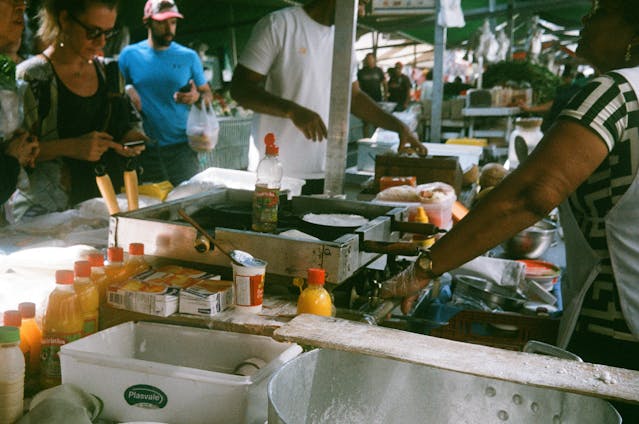
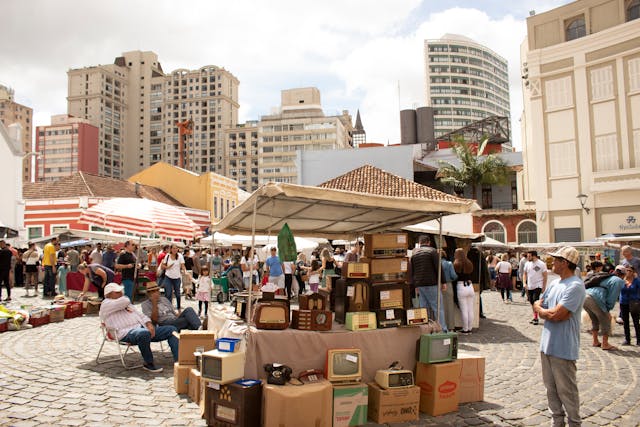
A feira (street market / open-air market) is one of the richest places to hear real Brazilian Portuguese in motion. A feira is not just a place where people buy fruit, vegetables, snacks, or household items. A feira has its own rhythm, its own sound, and almost its own register. For many learners, stepping into a feira feels overwhelming at first. For me, that is exactly why it is such a powerful place to learn how language, culture, and everyday interaction come together in Brazil.
What to listen for at a Brazilian feira or street market
When I show videos of Brazilian markets to students, they usually notice the chaos first. They hear overlapping voices, fast speech, repeated phrases, laughter, and vendor call-outs coming from every direction. That reaction is very common. I usually tell them not to try to decode everything at once. A feira makes more sense when you listen for patterns first.
I encourage students to pay attention to repeated expressions, rhythm, and tone. Vendors often use a kind of musical speech to attract attention, and that rhythm matters as much as the words. Students may hear quick greetings, price calls, and negotiation language all mixed together. They may hear phrases like Tá na promoção! (It’s on sale!), Olha a fruta fresca! (Look at the fresh fruit!), or Pode chegar! (Come on over!). The exact wording changes, but the important thing is learning to hear the energy and intention behind it.
This is where listening practice becomes cultural practice too. My students often react by saying things like Que atmosfera caótica (What a chaotic atmosphere) or asking As pessoas ali estão negociando o preço? (Are people there negotiating the price?). That is the perfect teaching moment, because little by little the chaos starts to feel organized. Learners begin to recognize not only words, but interactional patterns.
How vendors use compliments, humour, and informal language in Brazil
In a feira, vendors are often performing as much as selling. They use compliments, jokes, warmth, and playful informality to create connection and keep the exchange alive. A vendor may say Oi, meu bem (Hi, my dear) or Hoje você está um charme (You look great today / You look charming today) before even mentioning the product. In another context, that might feel intrusive. In a Brazilian market, it is often part of how vendors create a friendly atmosphere and show appreciation for the customer’s presence.
Humour matters a lot too. Brazilians often joke in commercial interactions, and feira vendors do that very naturally. A little banter helps lower distance and makes people more open to staying, asking questions, and buying. In my experience, learners understand the vocabulary much faster once they realize that this informality is not random. It is part of the social script.
I have seen this clearly with students who visited Brazil or watched market videos in class. At first, they hear noise and pressure. Later, they start hearing friendliness, rhythm, and charm. That shift is important. Once a student stops hearing the feira as pure confusion and starts hearing it as a living language environment, the feira becomes one of the best places to understand how Brazilians really speak.
How to Practice Brazilian Portuguese for Real Shopping Situations
Learning shopping language in Brazilian Portuguese takes more than memorizing a few useful expressions. In real life, you need to recognize the vocabulary quickly, understand the rhythm of the interaction, and feel comfortable enough to respond without freezing. That is why I always recommend a gradual approach. What follows is a step by step guide to building shopping confidence in Brazilian Portuguese, followed by the most common mistakes foreigners make when shopping in Brazil.
A step by step guide to building shopping confidence in Brazilian Portuguese
- Start with the core shopping vocabulary first. Build a small base of high-frequency words and phrases before trying to improvise. Focus on expressions such as Quanto custa? (How much does it cost?), Quanto tá isso? (How much is this?), Posso ajudar? (Can I help?), Tô só olhando (I’m just looking), Vou levar (I’ll take it), Tem menor? (Do you have a smaller one?), Tem em outra cor? (Do you have it in another colour?), débito ou crédito? (debit or credit?), and vai parcelar? (are you going to pay in installments?).
- Create flashcards with context, not just translation. On one side, write the Portuguese phrase. On the other side, write the translation and one note about when it is used. For example, with Tô só olhando (I’m just looking), add a note saying that it sounds softer and more natural than a blunt refusal. That extra note helps you remember the social function, not only the meaning.
- Keep a shopping notebook with categories. Divide it into sections like greetings, asking for prices, asking for sizes, bargaining, paying, and refusing politely. This helps your brain organize the language by situation. I find this much more effective than keeping a random list of words.
- Record audio notes for yourself. Say the phrases aloud and save them on your phone. Then listen back while walking, commuting, or doing something else. This helps you get used to the rhythm of the language. Shopping Portuguese is often fast and reduced, so hearing yourself and hearing the phrases repeatedly makes a big difference.
- Repeat the phrases aloud until they sound physically natural. I always tell students that a phrase is not really learned when it only looks familiar on paper. A phrase is learned when your mouth knows what to do with it. Repeat expressions like Quanto tá isso? (How much is this?) and Vou levar (I’ll take it) until they come out smoothly.
- Listen to real Brazilian content with shopping scenes. Start with accessible materials such as our Brazilian music playlist and Portuguese song recommendations, then move on to YouTube videos, telenovelas, and audiobooks in Portuguese. Pay attention to what people repeat, pronunciation and intonation patterns, and how much gets shortened in speech. Do not try to understand everything at once. Listen for patterns first.
- Shadow short dialogues. Choose a simple shopping exchange and repeat each line right after the speaker, copying rhythm and intonation. This is one of the best ways to sound more natural. In Brazil, tone matters almost as much as vocabulary, so shadowing helps you absorb both.
- Practice roleplay with a teacher, tutor, or language partner. Act out situations like buying fruit at a feira, asking for a different size in a clothing store, or negotiating with a beach vendor. Start with simple scripts, then repeat them with slight changes. Roleplay is where passive knowledge starts becoming active confidence.
- Add one social layer at a time. First learn the practical phrase. Then add the greeting. Then add a warmer tone. Then add a follow-up question or a negotiation phrase. This is how students gradually move from survival Portuguese to more natural interaction.
- Practice bargaining separately from standard shopping. Negotiation has its own rhythm. Learn phrases like Tem como fazer um precinho pra mim? (Is there any way you could give me a little special price?) and Fecha em trinta pra mim? (Can you do thirty for me?) and practice them with a smile and relaxed tone. Bargaining in Brazil usually works better when it sounds warm and light.
- Train your ear for fast cashier language. Practice hearing phrases like débito ou crédito? (debit or credit?) and É pra presente? (Is it a gift?) because cashiers often say them quickly. Many learners know the words but still miss the phrase in real time.
- Review after every real or simulated interaction. Write down what you understood, what you missed, and which phrase you wish you had known. That reflection helps you improve much faster than just moving on and forgetting the moment.
The most common mistakes foreigners make when shopping in Brazil
“Shopping in Brazil becomes much more enjoyable when you stop seeing it as a simple exchange of money for goods and start understanding it as a social interaction shaped by tone, warmth, politeness, and cultural instinct.” – Lucas Abiko
- Going straight to the point without a greeting. Starting with Quanto custa? (How much does it cost?) with no opening may sound too abrupt, especially in smaller shops, markets, or stalls.
- Using textbook Portuguese that sounds too stiff. Grammatically correct Portuguese is useful, but real shopping interactions in Brazil are often more reduced and informal. Saying everything too formally may create distance.
- Mistaking warmth for intrusion. A vendor calling you meu bem (my dear) or querida (dear) may feel overly personal at first, but in many Brazilian contexts it is simply part of a warm politeness system.
- Trying to bargain in the wrong places. Bargaining is common at a feira (street market), with beach vendors, and at informal stalls. Bargaining in supermarkets or chain stores usually feels out of place, unless the conversation is about paying à vista (in one single payment) or in cash.
- Bargaining too aggressively. In Brazil, negotiation usually works better with humour, softening, and friendliness. A harsh or confrontational tone may damage the interaction quickly.
- Ignoring diminutives. Expressions like precinho (little special price) or promoçãozinha (little promotion) are not childish. They often make the interaction sound softer and more natural.
- Translating everything too literally. Learners sometimes focus only on dictionary meaning and miss the social meaning. A phrase may sound warmer, lighter, or less direct than the literal translation suggests.
- Using too much slang too early. A few natural expressions help a lot. Too many Portuguese slang words at once may sound forced, especially when the learner has not yet internalized the tone.
- Not preparing for payment language. Many foreigners are surprised by questions like débito ou crédito? (debit or credit?) or vai parcelar? (are you going to pay in installments?). These are extremely common and worth practicing early.
- Freezing when they do not know one word. In real life, you do not need perfect vocabulary for every item. Phrases like Quanto tá isso? (How much is this?) help you function even when you cannot name the object.
- Expecting shopping to be purely transactional. In Brazil, shopping often includes small talk, warmth, humour, and relational language. Learners who understand that usually relax more and communicate better.
Shopping in Brazil becomes much more enjoyable when you stop seeing it as a simple exchange of money for goods and start understanding it as a social interaction shaped by tone, warmth, politeness, and cultural instinct. The right words matter, but the right rhythm matters too. Once you begin to recognize how greetings, diminutives, humour, and small talk work in real Brazilian Portuguese, everyday transactions stop feeling confusing and start feeling natural. That is the point where language begins to open doors not just to communication, but to real cultural participation.
That kind of progress becomes much easier with personal guidance. At Language Trainers, students work one to one with an experienced native teacher who adapts the lessons to their level, goals, and learning style. Some students want face-to-face Portuguese lessons so they can build confidence through real interaction and pick up gesture, tone, and social nuance more naturally. Others prefer Portuguese online classes that fit more easily into a busy schedule while still offering personalized support and cultural insight.
→Sign Up Now: Free Trial Portuguese Lesson With a Native Teacher!←
One student described that experience beautifully:
“I am indeed enjoying the classes and I’m very happy that Cristina is my teacher. She’s very kind and understanding. She’s helping me a lot and has a lot of patience. I chose Language Trainers as they seemed to have a good reputation, and they work with large companies. So to me, that says a lot. Everything is going well and I”m hoping to continue to learn.”
Timothy Clarkin
Portuguese course online
Book a free trial lesson with Language Trainers and start building real confidence in Brazilian Portuguese through one to one face to face Portuguese lessons or personalized online classes. Contact us today!
Frequently Asked Questions About Shopping in Brazil
1. What are the most useful Brazilian Portuguese shopping phrases?
Some of the most useful Brazilian Portuguese shopping phrases include Quanto custa? (How much does it cost?), Quanto tá isso? (How much is this?), Tô só olhando (I’m just looking), Vou levar (I’ll take it), and Tem menor? (Do you have a smaller one?). These phrases help in real shopping situations because they cover greeting, asking, choosing, and buying. Learning them with the right tone makes a big difference.
2. Is bargaining common in Brazil?
Bargaining is common in informal places such as street stalls, open-air markets, beach vendors, and some smaller local businesses, and it is a huge part of beach culture in Brazil. In larger stores, shopping malls, and supermarkets, bargaining is much less common, although paying à vista (in one single payment) or in cash may still lead to a discount. The setting matters a lot. In Brazil, knowing where negotiation feels natural is part of shopping culture.
3. How do you ask for a discount in Brazilian Portuguese?
A very natural way to ask for a discount in Brazilian Portuguese is Tem como fazer um precinho pra mim? (Is there any way you could give me a little special price?). Another common option is Não rola um desconto, não? (Couldn’t you give me a discount?). Both phrases sound softer and more natural than a blunt request. In Brazil, friendliness and tone often matter just as much as the words.
4. What should foreigners know before shopping at a feira in Brazil?
Foreigners should know that a feira (street market / open-air market) is not only a place to buy things, but a lively social environment with fast speech, humour, negotiation, and lots of informal interaction. Vendors may greet you warmly, comment on the products, or try to start a conversation before talking about price. It helps to stay relaxed, listen for repeated phrases, and remember that the atmosphere may feel chaotic at first but becomes easier with exposure.
────────────────────────────────────────
About the author
Lucas is a qualified Portuguese instructor who has been teaching Portuguese as a Foreign Language since 2020 to learners from diverse linguistic and cultural backgrounds. He holds a Bachelor’s Degree in Translation and Interpreting, specializing in Brazilian and European Portuguese, and a Postgraduate Certificate in Portuguese as a Foreign Language, with a strong focus on methodology and proficiency-based instruction. Alongside teaching, Lucas has worked professionally as a Portuguese–Japanese interpreter and translator in legal and international institutional settings across Europe and Asia, bringing a high level of linguistic precision and real-world expertise to his teaching practice.