


Soccer expressions across the Spanish-speaking world are never just about soccer, and with the 2026 World Cup getting closer, these expressions are about to become even more visible. They are clues about identity, humor, class, pressure, loyalty, and the way each country turns the game into everyday language. If you can recognize whether someone says ponerse la 10, estar la pelota en el tejado, or de a chesco, you are not just identifying vocabulary. You are identifying a whole cultural world. That is why soccer language is such a good way to build Spanish variety awareness and understand how Spanish really works across countries.
I have felt that very clearly both in Argentina and abroad. I grew up in Rosario, where soccer was not a weekend hobby but part of the emotional structure of family life. Later, after moving to Spain and watching matches with friends from different countries, I started noticing just how much soccer vocabulary changes from one place to another. The literal meaning may be easy enough to decode, but the emotional weight, the humor, and the social tone can be completely different. That is where things get really interesting.
→Sign Up Now: Free Trial Spanish Lesson With a Native Teacher!←
Why Soccer Expressions Reveal So Much About Spanish-Speaking Cultures
Soccer expressions reveal so much because soccer is one of the few shared reference systems powerful enough to cross generations, social classes, and regions. In many Spanish-speaking countries, people do not keep soccer language neatly inside the stadium. They import it into family arguments, office life, friendships, politics, and ordinary conversation. A soccer phrase becomes useful because it is visual, emotional, and instantly understood.
That transfer happens everywhere, but each country does it in its own way. In Spain, many soccer expressions have moved into everyday language through the media and now sound almost neutral in general conversation. In Mexico, soccer language often carries neighborhood humor, street rules, and a playful sense of bravado. In Argentina, the language of soccer feels even more intimate and structural. It is one of the main ways we talk about responsibility, betrayal, courage, collapse, and commitment.
That difference matters for learners. A student may understand every word in a sentence and still miss the real meaning if they do not know the soccer culture behind it. That is why I find this topic so rich. Soccer vocabulary is not only slang. It is a map of how each society feels pressure, loyalty, and conflict.
Soccer Language in Argentina: Passion, Pressure, and Confrontation
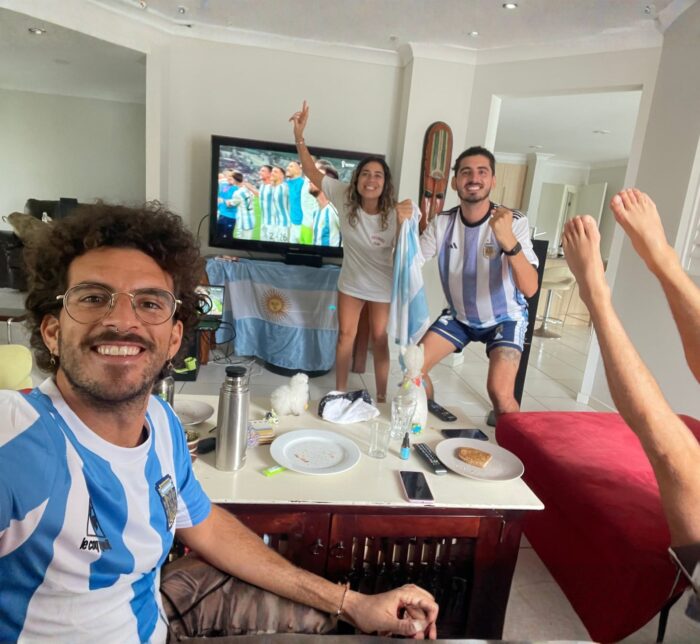
In Argentina, soccer language feels inseparable from daily life because soccer itself is inseparable from identity. Growing up in Rosario, I did not experience soccer as background entertainment. I experienced it as family structure, weekend rhythm, and social belonging. If Newell’s played away, the match anchored the long family sobremesa after lunch, with the radio often running over mates and conversation. If Newell’s played at home, everything changed. Lunch was shorter, the rhythm of the day accelerated, and we moved toward the stadium. Even blocks away, you could already hear the drums and the chants.
That atmosphere shapes the language. In Argentina, soccer expressions are not decorative. They are one of the main ways we talk about life when life becomes tense, unfair, demanding, or emotionally charged. We use soccer language because it feels more human than textbook phrasing. A standard, over-polite sentence often sounds cold to us in moments that require loyalty or emotional truth. Soccer language solves that by giving us vivid metaphors for pressure, effort, leadership, collapse, and betrayal.
What “Ponerse la 10” Means in Argentina
Literally, ponerse la 10 means “to put on the number 10 shirt.” In Argentina, that number is not just any shirt number. It is the most symbolically important shirt in soccer because it is tied to two figures who define the country’s soccer imagination more than anyone else: Diego Maradona and Lionel Messi. The number 10 is the shirt of the player expected to invent, lead, unlock the match, and carry the team when everything is stuck. That is why the phrase has such force.
In real life, ponerse la 10 means stepping up when a situation becomes difficult and taking decisive responsibility for everyone else. It is not just helping out a little. It is assuming the burden in a way that changes the outcome. When we say someone se puso la 10, we mean that person did not disappear under pressure. They became the one who made things happen.
A very natural example would be: “We were two days from the deadline, three people from the group vanished, and Martín put on the number 10 and finished the whole presentation himself.” Another would be: “My sister put on the number 10 for Sunday lunch and organized everything when the rest of us were useless.”
Culturally, the phrase matters because it turns leadership into something visible and embodied. In Argentina, leadership is not an abstract managerial quality. Leadership is what appears when the situation gets hard and somebody takes responsibility the way the number 10 is supposed to do on the pitch.
What “Transpirar la camiseta” Means in Argentina
Literally, transpirar la camiseta means “to sweat through the shirt.” In soccer, the image is obvious: a player who works so hard for the team that the jersey becomes soaked. In Argentina, the phrase moved naturally into daily life.
In real use, transpirar la camiseta means giving a full, committed effort for a collective cause. It can apply to work, family, study, or friendship, but the key idea is always the same: real commitment should be visible. Someone who only does the minimum has not transpirado la camiseta. Someone who sacrifices comfort and truly pushes for the group has.
A sentence like “The whole team sweated the shirt to close the project on time” sounds perfectly natural in Argentine Spanish. So does “My father sweated the shirt his whole life so we could go to university.” That is exactly the point. In Argentina, soccer vocabulary rarely stays inside soccer. It spills naturally into work, family life, school, friendship, and any situation where effort, loyalty, or pressure are involved. Transpirar la camiseta works so well outside the pitch because it carries a very specific moral idea: real commitment should be visible, concrete, and collective. It turns ordinary effort into something emotionally legible, which is why soccer language travels so easily into the rest of life.
What “Ir al frente” and “Cortita y al pie” Sound Like in Real Argentine Spanish
These two expressions say a lot about Argentine communication because together they show how much we value courage and directness.
Literally, ir al frente means “to go to the front.” In soccer, it suggests pushing forward instead of hiding. In daily life, it means facing a problem directly, speaking honestly, or taking responsibility without excuses. If a boss protects the team and admits what went wrong, we say fue al frente. If someone avoids the issue and speaks in vague corporate language, the phrase would never apply.
A good example would be: “When the plan failed, she went to the front and told the client the truth.” The phrase sounds strong because it frames honesty as a form of bravery.
Cortita y al pie is different, but related. Literally, it means “short and to the foot.” In soccer, it refers to a precise short pass delivered exactly where the teammate needs it. In daily conversation, it means “keep it simple, clear, and direct.” It is what we say when we want someone to stop surrounding the point with unnecessary explanation.
If I ask a friend, “Cortita y al pie, are you coming or not?” the meaning is not rude in Argentina. It is efficient, familiar, and very natural. It asks for clarity without ceremony.
Together, these expressions reveal something important. Argentine Spanish often prefers a kind of emotional and verbal directness that feels closer to a fast soccer move than to bureaucratic politeness. That is why these phrases survive so easily outside sport.
What “Pechearla” and “Aguantar los trapos” Reveal About Argentine Soccer Culture
These two expressions sit at opposite emotional poles, and that contrast tells you a lot about Argentina.
Pechearla is one of the harshest soccer-derived verbs we use. Its roots are connected to pecho frío, literally “cold chest,” a classic insult for a player who lacks fire or courage in decisive moments. In everyday use, pechearla means choking under pressure, collapsing when success was within reach, or failing because of psychological weakness rather than lack of talent.
If someone had the exam under control and then froze at the end, we might say: “He had it in his hands and choked it at the last minute.” In Argentine Spanish, pechearla is not just failing. It is failing in the most disappointing possible way, when the moment demanded nerve.
Aguantar los trapos, by contrast, comes from terrace culture. Literally, it means “to hold up the banners,” with trapos referring to the flags and banners of the supporters. In real use, it means staying loyal, standing by your side, and keeping faith in bad moments. It can apply to soccer, but also to friendship, family, or any group identity under pressure.
A sentence like “When everything got ugly, she was the one who stayed and held up the banners” would make perfect sense in Argentina. The phrase is about presence and loyalty when things stop being easy.
Together, these two expressions show the emotional core of Argentine soccer culture. We are obsessed with how people behave in decisive moments. Do they collapse, or do they stay? Do they disappear, or do they hold the line? That is why these expressions travel so easily into ordinary life.
What “Pecho frío” Means in Argentina and Why It Hurts So Much
Literally, pecho frío means “cold chest.” In soccer, it describes a player who lacks passion, nerve, or emotional commitment in the moments that matter most. But in Argentina, the phrase hits harder than a simple accusation of poor performance.
Calling someone pecho frío is not just saying they played badly. It is saying they failed a moral and emotional test. They did not feel the shirt. They did not rise with the pressure. They did not respond with garra, that fierce Argentine idea of grit and inner fire. In a country where soccer is tied so deeply to identity and loyalty, that accusation cuts to the core.
That is why the phrase has moved beyond soccer too. You can call someone pecho frío in work, relationships, or any situation where a person seems emotionally absent when commitment is required. It is deeply insulting because it questions not only ability, but character.
A soccer insult becomes socially powerful when it captures a national fear, and pecho frío does exactly that. It names one of the worst things an Argentine sporting imagination can detect: a person who had the moment in front of them and did not show up for it.
Soccer Language in Spain: Precision, Evasion, and Tactical Metaphors
When I moved to Spain, I discovered very quickly that the sport was the same, but the language used to read it was not. I was still watching soccer, still reading pressure, tension, failure, and relief, but the verbal machinery around the match had changed. In Argentina, soccer language tends to feel raw, intimate, and emotionally overloaded. In Spain, especially in the soccer conversations I stepped into after arriving in 2016, the phrasing often felt more tactical, more mechanical, and sometimes more evasive. That difference became obvious to me in bars, living rooms, and post-match discussions, where I kept understanding the game itself but stumbling over the metaphors used to explain it. One of my clearest early memories is a Madrid Derby in a bar in Alicante, where phrases like cerrar la pinza and hacer la cama al míster sounded immediately vivid to local ears but strangely industrial or coded to mine. That contrast taught me something important. Soccer Spanish does not just vary in vocabulary. It varies in the way each country imagines pressure, teamwork, blame, and responsibility.
What “Cerrar la pinza” Means in Spain
Literally, cerrar la pinza means “to close the clamp” or “to close the pincers.” In ordinary Spanish, a pinza is a clip, clamp, or pincer-like tool that grips and immobilizes something. In Spanish soccer talk, the expression refers to a tactical move in which two defenders close in on an attacker from different angles and leave him with no route out. It is a very visual metaphor, but to my Rioplatense ear it sounded far more mechanical than the soccer language I grew up with.
That reaction is tied to lived experience. I remember watching a Real Madrid against Atlético match in Alicante in April 2017, when an Atlético winger tried to cut inside and two Madrid defenders shut the move down instantly. One of my Spanish friends jumped up and shouted, “¡Cómo le han cerrado la pinza!” The tactical meaning was perfectly clear, but the phrase itself landed differently for me. In Argentina, we would have been more likely to say le hicieron el dos-uno or lo escalonaron, expressions that feel more soccer-native to my ears. Cerrar la pinza sounded almost like carpentry or mechanical work. That is exactly why it is so interesting. In Spain, tactical suffocation is imagined through precision and compression.
A natural example outside pure match commentary would be something like, “The rivals tried to counter, but the full-back and the center-back closed the clamp on him and he had nowhere to go.” The literal image and the tactical meaning align tightly. That is a very Peninsular kind of soccer metaphor: practical, tight, and spatially precise.
What “Hacer la cama al míster” Means in Spanish Soccer
Literally, hacer la cama al míster means “to make the bed for the coach.” Outside soccer, hacerle la cama a alguien can mean setting someone up, undermining them, or quietly engineering their downfall. In soccer in Spain, the phrase refers to players deliberately underperforming in order to push the manager out. It is one of the sharpest ways to accuse a dressing room of betrayal.
I heard it in exactly that sense during the same period in Spain. In that same Madrid Derby atmosphere, once the match dynamics changed and one side began drifting, giving away easy balls and abandoning intensity, one of my Spanish friends exploded and said, “Le están haciendo la cama al míster.” I understood the complaint immediately, but the phrasing fascinated me. In Argentina, I would have expected something like van para atrás (“they’re holding back on purpose” / “they’re deliberately underperforming”) or le están tirando el bombo (“they’re throwing him under the bus” / “they’re trying to sabotage him”), both of which carry a darker, more openly hostile emotional charge.
A natural example would be, “The players stopped pressing, stopped running, and people started saying they were making the bed for the coach.” What makes the phrase powerful is that it turns poor performance into intentional sabotage. It is no longer about form. It is about hidden political action inside the squad. That tells you a lot about how Spanish soccer talk narrates crisis: through coded plots, not only through emotional collapse.
What “No dar pie con bola” Means in Spain
Literally, no dar pie con bola means something like “not to connect foot with ball.” In soccer terms, the image is straightforward. A player is so off rhythm, so inaccurate, or so out of sync that he cannot even make proper contact with the ball. In everyday Spanish in Spain, the phrase moved far beyond soccer and now means failing repeatedly, not getting anything right, or having a terrible run of errors.
This is a good example of how Peninsular soccer language traveled into daily speech. A Spaniard can say no doy pie con bola about a bad workday, a disastrous exam week, a failed string of dates, or even a simple morning where everything goes wrong. The soccer image remains underneath, but the phrase now functions as an ordinary diagnosis of incompetence or misfortune.
A perfectly natural example would be, “I’ve been so distracted this week that I can’t get anything right.” That everyday portability is important. It shows how soccer language in Spain often becomes normalized and loses some of the emotional heat it might carry in Argentina. The metaphor is still visual, but the tone is often lighter and more generally usable.
What “Estar la pelota en el tejado” Means in Everyday Spanish
Literally, estar la pelota en el tejado means “the ball is on the roof.” The image comes from soccer or street play: once the ball ends up on someone’s roof, the next move depends on whoever controls access to it. In everyday Spanish, especially in Spain, the phrase means that the next step or the responsibility now lies with the other person or the other side. The matter is pending, but the initiative is no longer yours.
This is one of the clearest examples of soccer language becoming fully embedded in general Spanish. Spaniards use it in politics, relationships, work disputes, negotiations, and casual conversation. Someone can say, “We already sent the proposal. Now the ball is on their roof,” and nobody needs the soccer context explained. The image is settled and culturally shared.
That kind of metaphor fascinates me because it shows a different route from the Argentine one. In Argentina, soccer expressions often stay hotter, more emotionally marked, more tied to loyalty, pressure, or collapse. In Spain, many soccer metaphors have become almost administrative in their flexibility. Estar la pelota en el tejado is a perfect example. It is soccer-born, but it now sounds like everyday strategic reasoning.
Soccer Language in Mexico: Street Matches, Humor, and Pure Nerve
Mexican soccer language feels different from both the Argentine and the Peninsular varieties because it carries more barrio energy, more playful bravado, and a very particular kind of fatalistic humor. When I first started hearing Mexican soccer talk closely, what struck me was not just the vocabulary itself, but the tone behind it. The game still carried pressure, frustration, and pride, of course, but the phrasing often came wrapped in wit, street logic, and quick-fire social codes that felt rooted in the cascarita, the informal neighborhood match as much as in the professional game.
A Mexican friend once explained to me that many of the most revealing expressions are the ones that come from those informal games, where the rules are improvised, the stakes are emotional, and everyone knows exactly what is at risk even if there is no referee and no official structure. That made immediate sense to me. In Argentina, soccer language also spills into daily life, but in Mexico I hear a stronger mix of neighborhood custom, humor, and sudden emotional collapse. The language feels agile, vivid, and very social.
What “Gol gana” Means in Mexico
Literally, gol gana means “goal wins.” In a Mexican street match, it is exactly what it sounds like: no matter what the score has been until then, the next goal decides everything. If you are losing 10–1 and someone says gol gana, the previous ten goals suddenly lose all value and the whole match becomes a single moment.
What makes the phrase so interesting is that it condenses the entire emotional logic of informal soccer. The match is no longer about cumulative merit. It becomes pure tension, pure nerve, pure survival. One goal rewrites the whole story. That is why the expression travels so easily beyond soccer. It captures the kind of sudden reversal that feels unfair, funny, and absolutely possible in life.
A natural example would be: “We had been arguing for an hour, but then the boss walked in and made one decision that changed everything. It was basically gol gana.” The phrase works because it turns chaos into a rule everybody instantly understands.
What “Gol o penal” Means in a Mexican Street Match
Literally, gol o penal means “goal or penalty.” In a Mexican street game, it is the rule people invoke when there is a disputed foul in the box and no referee to settle it. Instead of endless debate, the players resolve the moment with a direct penalty. It is a neighborhood solution to neighborhood uncertainty.
What I like about this expression is that it reveals how soccer language in Mexico grows out of improvisation. A cascarita does not need a polished institutional structure to feel intense. The rules are socially negotiated on the spot, and phrases like gol o penal carry that whole culture inside them. They sound casual, but they express a shared understanding of fairness, pressure, and urgency.
A Mexican friend once laughed while explaining that the phrase only works because everybody already knows the emotional script around it. It is not a technical rule written anywhere. It is an accepted street logic. That kind of expression tells you a lot about Mexican soccer culture: it is organized as much by social instinct as by formal procedure.
What “De a chesco” Means in Mexico
Literally, de a chesco means something like “for a soda” or “playing for soft drinks,” with chesco being a colloquial Mexican word for a fizzy drink. In a neighborhood soccer match, it refers to a classic bet: the losing team has to buy the winners their drinks afterward.
That phrase is small, but culturally it says a lot. It shows how soccer in Mexico often lives in a social world where the match continues after the final whistle. The game is tied to hanging out, joking, teasing, and paying up. The stake is modest, but the emotional investment is real. Because it is a barrio expression, it carries that whole atmosphere of informal competition and local belonging.
A natural example would be: “We played for sodas, and of course the team that had been talking the most ended up losing.” The beauty of de a chesco is that it makes the match feel communal and grounded. The reward is not abstract glory. It is a very tangible little ritual of winning and losing together.
What “Centro a la olla” Means in Mexican Soccer
Literally, centro a la olla means “a cross into the pot.” In soccer terms, it refers to a long, high ball sent straight into the penalty area, usually with the hope that any striker or arriving player can get a touch on it, often with the head. The image of the olla, the pot, turns the box into a crowded place where the ball is thrown in and chaos is expected to produce something.
That metaphor is brilliant because it gives the move a very physical and domestic image. It is not elegant, surgical soccer. It is a delivery into a packed, boiling zone where anything can happen. Mexican soccer language often does this well: it takes a tactical action and translates it into something vivid and almost comic.
A good example would be: “They had no idea how to break the defense down, so in the final minutes they just started pumping crosses into the pot.” Even outside Mexico, the phrase is understandable. But inside Mexican soccer speech, it carries a stronger texture. It sounds immediate, practical, and full of the disorder that the move is meant to create.
What “Villamelón” Says About Soccer Culture in Mexico
Villamelón is one of the most culturally loaded soccer words in Mexican Spanish. Today, it refers to the kind of fan who only supports the team when it is winning, or who suddenly becomes intensely interested in soccer only during the biggest moments, like the Liguilla or a major international tournament. In English, the closest idea would be a glory hunter or a fair-weather fan, but villamelón carries more social mockery than either of those.
What makes the word even more interesting is its literary and cultural history. Its deeper origin is usually traced back to the 1891 Spanish novel Pequeñeces by Father Coloma, which includes an aristocratic and pretentious character called the Marqués de Villamelón, a vain and ignorant man who spoke with false authority. The term later took root in Mexico through bullfighting journalism, where writers used it mockingly for supposed “fans” in the stands who spoke with total confidence despite having no real knowledge of what they were watching. From there, the word crossed naturally into soccer.
That background helps explain why villamelón is not just “a casual fan.” It is a word for somebody whose performance of fandom feels fake, shallow, or socially unserious. A villamelón is not being accused only of showing up late. A villamelón is being accused of pretending to belong. That says a lot about soccer culture in Mexico, where support is treated as something that should survive frustration, disappointment, and embarrassment, not just victories.
How Soccer Language Is Changing for Younger Spanish Speakers
One thing I have become very aware of in recent years is that soccer language does not stay still even inside one country. The expressions I grew up with are still alive, but they are no longer alone. Younger speakers are layering soccer talk with meme culture, streaming culture, TikTok irony, gaming language, and hyper-fast online slang. The result is not the disappearance of older soccer language, but a new hybrid dialect where traditional expressions coexist with digital ones. Living in Spain and listening from a distance has made that even more obvious to me. Every time I hear kids in Argentina speak, I can feel the vocabulary shifting under my feet.
The New Soccer Slang I Hear from Kids in Argentina Today
What surprises me most is not that the new slang exists, but how quickly it mutates. If I listen to my eight-year-old nephew and his friends in Argentina, I hear a version of soccer Spanish that still carries the old emotional energy but packages it differently. They do not just say a player pecheó anymore. They might say he pecheó en HD, which adds a layer of ironic spectacle, as if the collapse were happening in ultra-high-definition humiliation. They do not only praise someone by saying he se puso la 10. They say he has aura or that he is cocinando (“he’s cooking”), borrowing directly from digital and streaming culture. I have even heard phrases like fantasmear for a player who vanishes when needed most, or revivió el fútbol as a dry, meme-like response to a terrible error or ridiculous passage of play.
What matters is that the underlying emotional needs remain the same. Kids still want language for brilliance, collapse, swagger, and ridicule. They still use soccer to explain pressure and social status. The difference is that the current generation is fusing terrace language with internet language, so the results feel faster, more ironic, and much more self-aware than the soccer Spanish I grew up with.
How Memes, TikTok, and Streaming Are Changing Soccer Spanish
Platforms like TikTok, streaming culture, and meme circulation are accelerating this change because they reward speed, exaggeration, and instantly recognizable shorthand. A traditional phrase like ponerse la 10 still works, but younger speakers may prefer something shorter, punchier, or more ironic if it spreads better online. The same thing happens with soccer actions. A classic word like gambeta is still part of Argentine soccer identity, but I now hear kids using expressions closer to romper tobillos (“break ankles”) because that is the kind of phrase that travels well across soccer clips, gaming clips, reaction videos, and social media banter.
What fascinates me is that this does not weaken soccer language. It proves how alive it is. The pitch remains a linguistic laboratory, just as it always was. The metaphors evolve, the references become more digital, and the rhythm speeds up, but the deeper impulse stays constant. We still use soccer to narrate pressure, beauty, humiliation, loyalty, and collapse. We are just doing it now through a vocabulary shaped as much by the terrace as by the algorithm.
Famous Soccer Quotes Across the Spanish-Speaking World
“The game may be the same, but the phrases people remember tell you exactly what each soccer culture chooses to honor.” – Juan Manuel Terol
One of the fastest ways to understand soccer culture in Spanish is through its most famous quotes. A great soccer quote does more than summarize a match or a career. It captures a country’s emotional relationship with the game. Some quotes become part of national memory because they express defiance, pain, pragmatism, ambition, or perspective in a way ordinary commentary never could. That is especially true in Argentina, Spain, and Mexico, where soccer language constantly spills into daily life.
1. “Yo me equivoqué y pagué, pero la pelota no se mancha.” – Diego Armando Maradona
Translation: “I made mistakes and I paid for them, but the ball does not get stained.”
This is one of the most famous soccer quotes in the Spanish-speaking world. Maradona said it during his farewell match in 2001, in an emotionally charged speech that mixed confession, self-defense, and reverence for the game. The context matters enormously. Maradona was speaking as a man whose life had been marked by scandals, addictions, contradictions, and public collapse, yet who still wanted to separate all of that from the sacredness of soccer itself.
That is why the quote became so powerful. La pelota no se mancha is not just about Maradona. It is about the idea that soccer, despite the damage done by people around it or within it, remains pure in its emotional core. In Argentina, the line became almost philosophical. People use it as a way of saying that something larger and more beautiful survives human failure.
2. “Al rival, ni agua.” – máxima histórica de la escuela de Carlos Bilardo
Translation: “Not even water for the opponent.”
This quote is deeply tied to the soccer culture associated with Carlos Bilardo and with a very specific Argentine vision of competition. The literal meaning is harsh and memorable. It suggests that in soccer, especially in high-stakes contexts, generosity toward the opponent has no place. You give them nothing. Not even water.
Culturally, the phrase became shorthand for extreme pragmatism, competitive obsession, and a win-at-all-costs mentality. Bilardo did not invent Argentine competitiveness, of course, but he became one of its strongest symbols. That is why the line survives so well. It condenses a whole worldview. Soccer here is not a polite exchange. It is a contest in which naivety is punished. Even outside sport, al rival, ni agua can still be used to describe an unforgiving or fiercely strategic attitude.
3. “Ganar, ganar y volver a ganar. Eso es el fútbol.” – Luis Aragonés
Translation: “Win, win, and win again. That is soccer.”
This quote is inseparable from Luis Aragonés and from the transformation of the Spanish national team. Aragonés popularized it as a statement of mentality, and it came to symbolize the shift that eventually led Spain to Euro 2008 and then into its great era of international dominance. The repetition is the point. Ganar, ganar y volver a ganar sounds relentless because it is meant to sound relentless.
Its significance goes beyond motivation. The phrase helped define a cultural transition in Spanish soccer, from talented underachievement to sustained belief in winning as a habit. That is why the line still carries so much force. It expresses a mentality rather than a tactic. In everyday life, people quote it when they want to evoke discipline, ambition, and the refusal to settle after one success.
4. “El fútbol es la más importante de las cosas menos importantes.” – Jorge Valdano
Translation: “Soccer is the most important of the least important things.”
This is probably one of the most elegant soccer reflections ever said in Spanish. Jorge Valdano, who has always spoken about soccer with unusual clarity and literary precision, uses the phrase to put the sport in perspective without diminishing its emotional power. The quote acknowledges that soccer is not life or death, not family, not health, not justice. And yet, among the things that are not ultimate, it occupies an enormous place.
That balance is what makes the line so enduring. It validates the passion without losing perspective. For many people, this is the perfect sentence to explain why soccer matters so much while still remaining, at the end of the day, a game. In the Spanish-speaking world, where soccer often absorbs huge amounts of emotion and identity, Valdano’s phrase offers a rare moment of calm intelligence.
5. “Imaginemos cosas chingonas.” – Javier “Chicharito” Hernández
Translation: “Let’s imagine awesome things.”
This line became famous through Javier “Chicharito” Hernández and quickly moved far beyond soccer. The key word here is chingonas, a very Mexican term that signals something bold, great, impressive, or exciting, with a tone that feels direct and culturally rooted. That is part of why the quote resonated so strongly. It did not sound corporate or polished. It sounded colloquial, optimistic, and distinctly Mexican.
Its significance lies in its emotional timing. The phrase became an invitation to dream bigger, to believe in the improbable, and to reject small-minded defeatism. In Mexico, where soccer often lives side by side with frustration and irony, imaginemos cosas chingonas felt like a burst of audacity. It became a slogan people used not only for sport, but for ambition more broadly. That is exactly what strong soccer language does. It escapes the pitch and enters collective speech.
6. “Los enanos nunca crecen.” – José Antonio Roca
Translation: “Dwarfs never grow.”
This is one of the harshest and most remembered lines in Mexican soccer history. José Antonio Roca used it as a dismissive, contemptuous phrase aimed at opponents, implying that some teams or players lacked the mental or tactical stature to rise in decisive moments. The quote is deliberately insulting, and that edge is part of why it survived.
Its significance has less to do with tactical insight than with soccer rhetoric as psychological warfare. Spanish-speaking soccer culture has always produced these cutting, theatrical lines that humiliate by reducing the rival to a permanent condition of inferiority. In this case, the line stuck because it captured arrogance, rivalry, and the brutal pleasure of putting an opponent in their place. It is not reflective like Valdano, nor redemptive like Maradona. It belongs to the aggressive, confrontational side of soccer speech.
Taken together, these quotes show just how different soccer language can feel across the Spanish-speaking world. Argentina often gives us tragedy, purity, and obsession. Spain gives us perspective and competitive doctrine. Mexico gives us bravado, rhythm, and emotionally charged popular language. The game may be the same, but the phrases people remember tell you exactly what each soccer culture chooses to honor.
Learn Spanish Through the Language People Actually Live
That is the real lesson behind all of these expressions, especially as the excitement around the 2026 World Cup continues to grow. Soccer Spanish is never just about football. It is about the way people in Argentina, Spain, Mexico, and the wider Spanish-speaking world turn pressure, loyalty, irony, defeat, and courage into language. During a World Cup, those expressions become even more alive because people use them in living rooms, bars, stadiums, group chats, headlines, and everyday conversations. Once you start hearing that, you stop treating Spanish as a list of equivalent words and start understanding Spanish as a living social system. That is where real fluency begins.
For me, that is why face-to-face learning matters so much. Soccer is powerful because it creates connection in real time. People are in the same room, reacting together, reading each other’s tone, timing, and energy. A strong language lesson works in a very similar way. When you are physically present with a teacher, the lesson feels more immediate, more memorable, and more human. You are not only learning vocabulary. You are learning rhythm, reaction, confidence, and the social texture of the language. With the 2026 World Cup bringing Spanish-speaking fans and cultures into the spotlight, that kind of learning becomes even more valuable.That kind of presence is exactly what many learners value most. As Lara Farnsworth, who took a 50-hour course in Greer, put it: “It’s very convenient to have the instructor come to you for the lesson! We had a very competent instructor who interacted wonderfully with my 15-year-old daughter.” What stands out in Lara Farnsworth’s testimonial is not only the convenience, but the quality of the human connection. A language becomes easier to remember when the learning experience feels personal, responsive, and fully engaged.
→Sign Up Now: Free Trial Spanish Lesson With a Native Teacher!←
At Language Trainers, that is what we aim for. Our face-to-face Spanish lessons, whenever available, and our online classes are built around your goals, your interests, and the kind of Spanish you actually want to understand. That may mean soccer language, everyday conversation, family communication, travel, or professional Spanish. Whatever the goal is, we help you learn the language as people really use it, whether you are studying at home or learning Spanish while traveling, so that when you hear expressions from Argentina, Spain, or Mexico, they feel alive instead of confusing.
Frequently Asked Questions About Soccer Expressions in Spanish
1. What are the most common soccer expressions in Argentina?
Some of the most common soccer expressions in Argentina are ponerse la 10 (“to put on the number 10 shirt,” meaning to step up and take responsibility), transpirar la camiseta (“to sweat through the shirt,” meaning to give a full committed effort), ir al frente (“to go to the front,” meaning to face things directly), cortita y al pie (“short and to the foot,” meaning keep it simple and clear), pechearla (“to lose nerve under pressure”), aguantar los trapos (“to hold up the banners,” meaning to stay loyal in bad moments), and pecho frío (“cold chest,” meaning someone who lacks passion or courage). What makes these expressions especially important is that they do not stay inside football. Argentines use them to talk about work, family, friendship, pressure, courage, loyalty, and collapse.
2. What are the most common soccer expressions in Spain?
Some of the most common soccer expressions in Spain are cerrar la pinza (“to close the clamp,” meaning to trap a player tactically), hacer la cama al míster (“to make the bed for the coach,” meaning to try to get the manager sacked by underperforming), no dar pie con bola (“not to connect foot with ball,” meaning not to get anything right), estar la pelota en el tejado (“the ball is on the roof,” meaning the next move depends on the other side), echar balones fuera (“to kick balls away,” meaning to avoid the issue), en el descuento (“in stoppage time,” meaning at the very last moment), and cortita y al pie (“short and to the foot,” meaning keep it brief and straightforward). Many of these expressions now sound completely natural outside football too, especially in journalism, politics, and everyday speech.
3. What are the most common soccer expressions in Mexico?
Some of the most common soccer expressions in Mexico are gol gana (“goal wins,” meaning the next goal decides everything), gol o penal (“goal or penalty,” used to settle a disputed foul in an informal game), de a chesco (“for a soda,” meaning the losing team buys the winners soft drinks), centro a la olla (“a cross into the pot,” meaning a high ball sent into the box), villamelón (“a fake or fair-weather fan”), and imaginemos cosas chingonas (“let’s imagine awesome things”). Many of these expressions come from the world of the cascarita (“informal street match”), which gives Mexican football language a strong neighborhood feel full of humor, nerves, and social ritual.
4. Why do so many Spanish speakers use soccer phrases in everyday conversation?
So many Spanish speakers use soccer phrases in everyday conversation because soccer provides a shared emotional language for pressure, failure, loyalty, timing, evasion, and triumph. Expressions like ponerse la 10 (“to step up”), no dar pie con bola (“to keep getting things wrong”), or gol gana (“one moment changes everything”) are vivid, memorable, and easy to apply outside the pitch. In Argentina, Spain, and Mexico alike, soccer metaphors help people say something quickly and vividly that more neutral textbook Spanish often cannot express as well.