




Soccer is one of the clearest reminders that English does not take you everywhere. For many native English speakers, the global status of English creates the idea that communication abroad will always be easy. With the 2026 World Cup squads for England, the USA, Canada, and Australia now confirmed, some of the most multilingual players heading to the tournament tell a different story.
These players moved abroad with a dream, joined dressing rooms full of different accents and nationalities, and learned that talent alone was not enough. To earn trust, understand coaches, connect with teammates, and feel at home in a new country, they had to learn new languages. Their stories show language learning as something practical, personal, and closely connected to ambition.
Learning a language becomes much more powerful when it is tied to something you truly care about. For these players, that passion was soccer. For other learners, it might be travel, music, food, film, family history, work, or the chance to live somewhere new. The lesson is the same. A new language helps people move toward the life they want.
In this article, we’ll look at multilingual players from England, the USA, Canada, and Australia, exploring how they learned languages through transfers, teammates, family heritage, and life abroad. Their stories show why learning a language is not just about speaking differently. It is about adapting, connecting, and getting closer to the goals that matter most.
→Sign Up Now: Free Trial Language Lesson With a Native Teacher!←
Multilingual Players to Watch in the USA’s Predicted World Cup Squad
The confirmed USMNT squad for the 2026 World Cup is one of the most internationally shaped groups in American soccer. Several of its players have built careers in Europe, including Christian Pulisic at AC Milan, Mark McKenzie at Toulouse, and other key names who have developed in leagues outside the United States. Their paths show how strongly this generation of American players has been shaped by soccer abroad.
The team’s multicultural identity goes beyond club locations. Folarin Balogun plays in France, Antonee Robinson has built much of his career in England, Tim Weah has played across Europe, and Johnny Cardoso brings a background connected to both American and Brazilian soccer. The focus here is more specific: the players below did not only grow up around different cultures. They learned or actively developed new languages because soccer took them away from home.
Mark McKenzie (English, Spanish, Dutch, German, and French)
Mark McKenzie’s language story is built around curiosity. A native English speaker from the United States, McKenzie has spent much of his career turning language learning into part of his growth as a player and as a person. Early in his career, he taught himself French and German while many players his age were still in college. That habit came from what one article described as his “unquenchable thirst for knowledge,” alongside other interests such as learning guitar and piano.
McKenzie’s language learning became even more practical as his career moved across Europe. After playing in Belgium, where he developed connections that he later called “second to none,” he joined Toulouse FC in France in 2024. French then became part of his daily life, not only a language he had studied from a distance.
Asked about his French after moving to France, McKenzie was honest about still being in the learning stage. “I have a little bit, but it’s growing daily,” he said. “I’m a language geek, so I enjoy it.” He explained that he already understood some French, but living in the country made the language feel different. The accents, speed, cadence, and regional differences all became part of the challenge.
That kind of answer says a lot about real language learning. McKenzie was not pretending to be fluent overnight. He was paying attention to the details that make a language feel alive. He noticed how people in the south of France speak differently from people in the north, and he treated those differences with curiosity rather than frustration.
His French was already useful in everyday situations. “I can say, ‘How are you doing? Have a good day, have a good night, good evening,’” he said. “I can ask them to get the check, please. I have the little things, so I can go out to dinner.” Those “little things” are often the first real victory for a language learner. They turn a foreign city into a place where you can move, eat, greet people, and begin to belong.
McKenzie’s approach to languages also fits his wider view of life abroad. Speaking about the connections he built at previous clubs, he said he wanted people to remember him as “genuinely a good guy” who was “kind” and “empathetic.” He added, “I really wanted to just leave a positive mark on the club, on the city, on the people during my time there.”
For McKenzie, language learning is part of that positive mark. Speaking even a little of someone else’s language shows attention, humility, and respect. It helps a player become more than a foreign signing passing through a club. It helps him become part of the city, the team, and the everyday relationships that make a place feel like home.
Weston McKennie (English, German, Italian, and Spanish)
Weston McKennie’s career shows how languages follow movement. He grew up partly in Germany because of his father’s military service, later returned to Germany to play for Schalke, and then became one of the most visible American players in Italy with Juventus.
German became part of McKennie’s identity as a Bundesliga player. While at Schalke, he worked under Domenico Tedesco, a coach known for switching between German, French, English, and Spanish on the training field. McKennie appreciated that Tedesco explained things in English when needed, but reports around his Schalke years noted that McKennie’s German, especially his accent, was impressive. McKennie turned the conversation into a joke about his own background, adding, “I’m from Dallas, I have to speak Spanish.”
That mix of German, English, Italian, and conversational Spanish reflects the reality of modern soccer. The dressing room is rarely one language, and McKennie’s career shows one reason bilingual people get paid more: language skills help players adapt, communicate, and compete in international environments.
McKennie’s Italian is perhaps the clearest example of his adult language development. At Juventus, he became comfortable enough to speak publicly in Italian, including in media and podcast appearances. In one widely shared interview, McKennie used Italian to challenge old stereotypes about American players in Serie A. He explained that when he arrived in Italy, people wondered whether an American could play soccer, but now Italy had players such as Christian Pulisic, Yunus Musah, Tanner Tessmann, Gianluca Busio, Timothy Weah, and McKennie himself proving the point on the field.
The message was about soccer, but the language made the message stronger. McKennie was not explaining American soccer through a translator. He was speaking inside the culture that had once doubted him. That is what language learning does at its best. It gives people the chance to represent themselves directly.
Christian Pulisic (English, German, and Italian)
Christian Pulisic’s story is one of the strongest examples of a native English speaker learning languages because his dream required it. Pulisic left Pennsylvania for Borussia Dortmund as a teenager, and the move was not easy. UEFA quoted him saying, “Coming here and not speaking a word of German is definitely different,” while explaining that moving to Dortmund was something he “had to do” to reach his ultimate goal.
Years later, Pulisic described the same move in even more personal terms. “That was the most difficult moment of my life,” he said. “I had to leave my family, my friends. I couldn’t speak the language at all. All that I brought with me to Germany, was a dream.”

Christian Pulisic, via Pinterest.
Pulisic did not go to Germany because German was easy, familiar, or optional. He went because the dream was bigger than the discomfort. German became part of the price of becoming a professional player in Europe.
His move to AC Milan later brought a new language challenge. In early 2024, Pulisic said he was taking Italian lessons and explained, “I’m doing my best, taking lessons. I can understand everything the coaches are saying!” By 2025 and 2026, videos of Pulisic speaking Italian after Milan matches had become a regular talking point among fans.
One Facebook post captured that reaction perfectly. The post showed Pulisic speaking Italian after winning a cup with AC Milan, and one commenter wrote: “Very impressive. He’s been in Italy less than 2 years, and he can speak like that? In addition to training a gazillion hours on the pitch, he also puts in the time to respectfully learn Italian. Way to go, CP10! Keep making us proud!”
That fan comment says what many language teachers tell students every day. People notice effort. They notice respect. They notice when someone who could hide behind English decides to meet others in their own language.
Pulisic’s teammate Rafael Leão has praised that effort too, saying that Pulisic speaks Italian “almost perfectly,” even with an American accent. The accent detail is important. Pulisic’s Italian does not need to erase where he comes from. The value lies in communication, effort, and connection.
The Most Multilingual Players in England’s Predicted World Cup Squad
England’s national team is often associated with the Premier League, the world’s most international domestic competition. English players train every day with teammates from Spain, Portugal, France, Brazil, Argentina, Germany, and many other countries. Despite that global environment, many English footballers have spent most of their careers in English-speaking settings, which makes the language efforts of players like Jude Bellingham, John Stones, and Reece James stand out.
These stories are especially useful for native English speakers. Bellingham, Stones, and James all reached the top of the game without needing another language to become elite players. Their decision to learn Spanish or use foreign-language phrases came from something deeper. They wanted to connect better, adapt faster, and show respect for the people around them.
Here are some of the most inspiring multilingual players from England’s 2026 World Cup squad.
Jude Bellingham (English, Spanish, and basic German)
Jude Bellingham’s move to Real Madrid turned Spanish into part of his daily life. As a native English speaker from Stourbridge in the West Midlands, Bellingham arrived in Spain with the profile of a superstar, but he still had to adapt like any other young player moving abroad. Learning Spanish became part of that adaptation.
Bellingham began using Spanish early in his Real Madrid career, first with short phrases in interviews and public appearances. Over time, he became much more comfortable using Spanish in post-match interviews, club duties, and celebrations with fans. His Spanish reflects the reality of language learning in a dressing room. It is not always formal, polished, or classroom-perfect. It is practical, social, and built through everyday contact.
One on-field Spanish interview shows why Bellingham’s effort has connected with so many fans. When the interviewer asked, “Oye, ¿en qué momento has mejorado tanto el español?” Bellingham replied, “Mi español es bien, pero no perfecto. Entonces perdona, lo siento, pero yo intento.” The interviewer answered with a warm “magnífico,” which captured the charm of the moment.
Bellingham’s answer is modest, and that modesty makes the exchange even more endearing. His Spanish has small mistakes, but the mistakes are part of what makes the effort feel real. Language learners often worry about sounding imperfect, especially in public. Bellingham shows the opposite lesson. Mistakes often make people appreciate the effort more, because mistakes prove that the person is trying rather than hiding behind English.
Bellingham’s language experience did not start in Spain. During his three years at Borussia Dortmund, he picked up enough German to understand and communicate at a basic level. Since joining Real Madrid, Spanish has clearly become his main language focus. In a multilingual dressing room, he has mentioned getting by with a casual mix of Spanglish, French, Portuguese, and other phrases. That kind of language mixing is common in soccer. Players do not always wait until they are fluent to communicate. They use what they have, build from there, and improve through contact.
John Stones (English and Spanish)
John Stones offers a different kind of language-learning story. He did not move to Spain, but Spanish still became useful in his career. At Manchester City, Stones worked under Pep Guardiola and played alongside Spanish-speaking teammates such as Nicolás Otamendi, as well as goalkeepers who communicated in Spanish or Portuguese. In that environment, learning Spanish was not about relocation. It was about becoming a better teammate and a more intelligent defender.
Stones revealed that Manchester City’s English defenders sometimes used Spanish during matches to communicate with teammates. “It’s a mix between Spanish and English,” he said when describing how the defense and goalkeepers interacted on the pitch. He explained the practical value clearly: “We kind of pick up the Spanish, and [Otamendi] is learning English, so it’s good to know what they’re saying and how to communicate with others on the pitch.”
That quote shows language learning at its most functional. Stones did not need perfect Spanish to benefit from it. Even basic instructions, repeated phrases, and match-specific vocabulary helped the defensive unit work more smoothly. In a sport where decisions happen in seconds, understanding a teammate’s words matters.
Stones’ Spanish-learning effort also fits his close tactical relationship with Guardiola. Under Guardiola, Stones moved beyond the role of a traditional center-back and became a hybrid defender and midfielder. That transformation required trust, tactical detail, and constant communication. Stones has often been seen discussing positioning and in-game adjustments with Guardiola on the sidelines, and his willingness to learn Spanish reflects the same mindset that reshaped his career.
For language learners, Stones’ example is especially encouraging. A new language does not need to become your whole life to become useful. A few phrases learned with purpose might improve a working relationship, make a team stronger, or help you understand the people guiding you.
Reece James (English and Spanish)
Reece James adds another interesting angle to England’s multilingual story because his Spanish has been noticed in a team environment rather than through a move abroad. The Chelsea captain is a native English speaker, but fans were surprised when a training video showed him speaking Spanish with teammates Enzo Fernández and Marc Cucurella.
The reaction to the video says a lot about how people view language effort in soccer. One Chelsea fan wrote, “Looks like Reece James is learning Spanish to talk to Enzo and make him feel comfortable. Future captain material.” That response connects language learning with leadership. James was not simply showing a hidden skill. He appeared to be using Spanish to make communication easier for teammates who had arrived from different football cultures.
Some fans immediately wondered whether the Spanish was a sign of a possible move to Spain, especially because Real Madrid is often linked with elite English players. Yet the more meaningful explanation is simpler and more human. At a club like Chelsea, Spanish helps players connect across nationalities, especially in a squad with Argentine, Spanish, Brazilian, and Portuguese-speaking influences.
That sense of empathy becomes even clearer when looking at how James has helped young Brazilian player Estêvão adapt to life at Chelsea. Estêvão has spoken about taking English lessons and slowly understanding his teammates better. He explained, “I’m starting to understand my teammates quite a lot now,” adding that the early progress comes through “the day-to-day stuff really, the routine, the everyday conversation.”
Reece James has reportedly helped Estêvão learn English football terminology, which creates a powerful learner-to-learner connection. James knows what it feels like to step outside his native language to communicate with teammates. Estêvão is now going through the same process in English. That shared experience makes language learning less abstract. It becomes part of how players welcome each other, guide each other, and build trust inside a dressing room.
James’ example shows that learning another language does not always begin with a transfer abroad. Sometimes it begins with empathy. A player sees a teammate adjusting to a new country, a new club, and a new language, and decides to meet him halfway. In a multilingual squad, that kind of effort is not only useful. It is a sign of leadership.
The Most Multilingual Canadian Players Predicted to Show Up at the 2026 World Cup
Canada’s national team reflects one of the most multicultural player pools in world soccer. Many of its players grew up between languages, cultures, and migration stories, which makes Canada a natural part of any conversation about multilingual footballers. Alphonso Davies, Maxime Crépeau, and Derek Cornelius show three different reasons a player might learn new languages.
Davies learned English after arriving in Canada as a refugee and later learned German at Bayern Munich. Crépeau grew up in French-speaking Quebec, built a career in English-speaking soccer environments, and added Spanish through family life and his wife’s Chilean heritage. Cornelius learned German after moving overseas as a teenager and later added further language exposure through a career that took him across Europe.
Together, their stories show that language learning does not always begin in a classroom. Sometimes it begins with migration. Sometimes it begins in a locker room. Sometimes it begins with love, family, and the desire to connect with someone else’s heritage.
Alphonso Davies (English and German)
Alphonso Davies’ language story begins long before Bayern Munich. Born in a refugee camp in Ghana to Liberian parents, Davies moved to Canada as a child and learned English while building a new life in Edmonton. English became his main public language, the language he uses in most interviews, and the language that helped him grow within Canadian soccer.
His move to Bayern Munich in 2019 brought another major language challenge. Davies arrived in Germany as one of the most exciting young players in world soccer, but talent did not remove the need to adapt. Bayern provided him with formal German lessons soon after his arrival, and daily life at the club gave him constant exposure to the language.
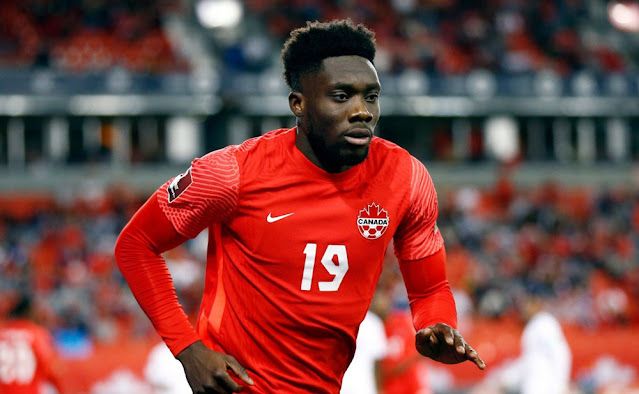
Alphonso Davies, via Pinterest.
Davies learned German through a mix of private instruction, locker-room immersion, and encouragement from teammates and coaches. Veterans such as Thiago Alcântara pushed him to speak German in training rather than defaulting to English, which helped him build confidence. That encouragement mattered because language learning often involves a personal barrier before it becomes a technical one. A player first has to stop feeling embarrassed about trying.
Within six months of arriving in Munich, Davies was already conducting interviews in German. That quick progress showed more than a gift for languages. It showed adaptability. Davies has linked his ability to handle new environments to leaving home at 14 to play professional soccer in Vancouver. By the time he moved to Germany, he already knew what it meant to live away from family, adjust to new people, and keep improving under pressure.
German gave Davies more than football vocabulary. It helped him connect with Bayern fans, understand the local culture, and become part of a club where communication matters as much as speed on the left wing. His story is a reminder that language learning often becomes easier when the reason behind it is clear. Davies had a team to join, a city to understand, and a career to build.
Maxime Crépeau (French, English, and Spanish)
Maxime Crépeau’s multilingual story is different because it connects professional soccer with home life. Born in Greenfield Park, Quebec, Crépeau grew up speaking French, his native language and the language he uses with his family. As his career developed across Major League Soccer and the Canadian national team, English became a major part of his professional life.
Crépeau’s career has taken him through Montreal, Vancouver, Los Angeles, Portland, and Orlando, all while representing Canada in a national team environment where English and French naturally coexist. Goalkeepers depend heavily on communication, which makes multilingual ability especially valuable. A goalkeeper has to organize defenders, give quick instructions, and build trust with teammates from different backgrounds.
Spanish entered Crépeau’s life through both soccer and family. His wife, Cristina, is from Quebec, and her mother immigrated to Canada from Chile. Through Cristina’s Chilean heritage and his relationship with his in-laws, Crépeau learned Spanish and brought it into a household where French, English, and Spanish all have a place.
That part of his story highlights another powerful reason to learn a language. A new language is not only useful for work, travel, or sport. A new language helps people connect with the culture of someone they love. In Crépeau’s case, Spanish is tied to family, heritage, and the everyday life he shares with his wife and children.
Learning Spanish through family makes the language personal. It is not only about speaking to teammates or coaches, though that matters in Southern California and other diverse soccer environments. It is about understanding jokes, traditions, memories, and relatives in a deeper way. Crépeau’s story shows that language learning often becomes most meaningful when it brings people closer at home.
Derek Cornelius (English, German, and French)
Derek Cornelius’ language story comes from an early leap into the unknown. Born and raised in Ajax, Ontario, to a Barbadian father and Jamaican mother, Cornelius grew up speaking English. His professional path changed quickly when he moved to Germany as a teenager in 2014 to play for VfB Lübeck.
That move placed him in a completely new environment at a young age. Germany was not just a football challenge. It was a language challenge, a cultural challenge, and a personal challenge. Cornelius later described that period with striking honesty: “I didn’t know the language, I didn’t know the culture, I didn’t know the people so I was really going into it cold turkey and just trying to figure out how I’m going to cope, how I’m going to handle it day by day.”
Those words show the emotional side of moving abroad. Cornelius did not arrive with everything figured out. He had to learn through necessity. Training, daily life, teammates, and the local environment pushed him to pick up German and develop a professional working proficiency in the language.
Cornelius did not describe that period as easy, but he did describe it as valuable. “All of that put together made me stronger mentally,” he said, “and then on the field being able to play with another player even though they don’t speak the same language as you. It was definitely a growing experience for me.”
That experience shaped the rest of his career. After Germany, Cornelius played in Serbia, returned to Canada with Vancouver Whitecaps, and later continued his journey through European leagues, including moves connected to Greece, Sweden, France, and Scotland. His time with Olympique de Marseille gave him further exposure to French, while his role with the Canadian national team placed him in a bilingual soccer culture where English and French both matter.
Cornelius’ story brings out one of the toughest but most inspiring parts of language learning. Sometimes the first stage is uncomfortable. You do not know the words, the people, or the culture yet. Day by day, that discomfort turns into resilience. For Cornelius, learning to survive abroad became part of becoming the kind of player who kept chasing new challenges.
The Most Multilingual Players in Australia’s Predicted World Cup Squad
Australia’s national team has always reflected the country’s multicultural identity. Many Socceroos come from families with roots in Europe, Asia, the Middle East, and other parts of the world, and many have built careers that took them far beyond Australia’s domestic leagues. That mix makes language learning a natural part of the Australian soccer story, whether it comes through heritage, education, or the need to adapt abroad.
Here are some of the most multilingual players from the confirmed 2026 Australia World Cup squad. Paul Okon-Engstlershow how language learning enters soccer in different ways: through family heritage, through the difficult reality of moving abroad, and through the need to adapt to European football environments where English is not enough.
Paul Okon-Engstler (English, French, Spanish, Dutch, and Italian)
Paul Okon-Engstler’s multilingual background comes from a football family that treated languages and cultural experience as part of a player’s development. Born in Belgium while his father, former Socceroo Paul Okon, was playing for Oostende, Okon-Engstler had an international story from the beginning.
After spending part of his childhood in Australia, he returned to Belgium in 2019 to join Club Brugge and later continued his development in Europe with Benfica’s academy in Portugal. That path placed him around different languages early: Dutch and French in Belgium, Portuguese in Portugal, and Spanish and Italian through family background and daily life.
His father has spoken clearly about why that international exposure mattered. “My country is beautiful, but we want to provide our four children with life experiences,” Paul Okon senior told ESPN. “I moved to Brugge when I was 19, and it helped me with my development.” He also explained that he and his wife, Yamaira, wanted their sons to experience different cultures and learn Dutch and French.
The family’s home life was multilingual too. “We kinda have a crazy life,” Okon senior said. “I met Yamaira in Italy, and we speak Italian at home. My wife has roots in Cuba, and her family lives in Miami.”
Okon-Engstler’s example shows how language learning can begin long before a player reaches the senior international stage. A young player who grows up between Belgium, Australia, Portugal, and a multilingual household does not only collect vocabulary. He learns to move between people, cultures, and styles of communication.
Aiden O’Neill (English, French, Italian, and basic German)
Aiden O’Neill’s language journey shows a more difficult side of learning abroad. A native English speaker from Australia, O’Neill developed French and Italian during his professional career in Europe, along with some knowledge of German. His time in Belgium, in particular, exposed him to the everyday challenge of living and working through a language barrier.
That part of his story matters because learning a language is not always a smooth or romantic experience. Moving abroad as a professional player means dealing with training demands, tactical instructions, contracts, housing, transport, paperwork, and ordinary routines in an unfamiliar language. The football might be the dream, but daily life around the football still has to be solved.
O’Neill’s experience shows that struggling with a language does not mean the learning process is going badly. It often means the player is right in the middle of the hardest and most important stage. At first, a language barrier feels isolating. Then repeated contact, small conversations, mistakes, and practical necessity begin to turn that barrier into a skill.
That lesson is useful for any learner. Fluency rarely arrives in a clean, straight line. Some days feel easier than others. Some conversations expose every gap at once. A player like O’Neill reminds learners that pushing through those uncomfortable stages is already part of the achievement. Language learning is not only about eventually sounding confident. It is about continuing to show up before that confidence has fully arrived.
Ajdin Hrustić (English, Bosnian, and German)
Ajdin Hrustić’s multilingual background reflects both his family roots and his European football journey. Born and raised in Melbourne, he speaks English as his native language. Through his Bosnian father, Enes, he grew up connected to Bosnian language and culture, which gave him another linguistic foundation before his career took him abroad.
German became important when Hrustić moved through European football as a young player. After time in England and Austria, he joined Schalke’s respected Knappenschmiede academy, where he developed in a German-speaking environment alongside future stars such as Leroy Sané. That immersion helped him become comfortable with the language long before his later Bundesliga spell with Eintracht Frankfurt.
Hrustić did not arrive in Germany with only English behind him. His Bosnian roots meant he was already used to moving between languages and cultures, which made the next step less intimidating. German then helped him settle into elite European football, understand coaches, and connect with teammates in one of the world’s strongest soccer cultures.
For Hrustić, languages were not extra skills on the side. English remained the language of his Australian identity, Bosnian kept him connected to his family background, and German became part of the career he built abroad. Together, those languages helped a Melbourne-born player turn movement into opportunity.
→Sign Up Now: Free Trial Language Lesson With a Native Teacher!←
Learn a Language That Helps You Move Toward Your Goals
These players did not learn languages because someone told them it would look good on a résumé. They learned because language became part of the life they wanted. Spanish helped players connect with Real Madrid fans and teammates. German helped young players settle into Bundesliga dressing rooms. Italian and French helped Americans build careers in Europe. Hebrew, Spanish, French, and other languages connected players with family stories, partners, teammates, and communities.
That is the real power of language learning. A new language gives a dream more shape. It makes a destination feel less distant, a career goal feel more realistic, and a family history feel more alive. For some learners, the goal is walking through Tokyo, Madrid, Paris, or Buenos Aires with more confidence. For others, the goal is building international career opportunities, speaking with clients, or preparing for work abroad. For many, the goal is more personal: reconnecting with their cultural heritage, understanding a partner’s culture, or passing a heritage language on to the next generation.
Language Trainers helps learners turn those goals into a practical learning plan. Jacob from New York experienced this through a 40-hour face-to-face Russian course with his teacher, Vera. As he put it, “I am loving every part of the course! I have gained more language skills and used them to talk to more people than ever before, and so have made new friends and contacts. Thanks very much for helping me take another step closer to achieving my dreams.”
Our native-speaking teachers design personalized lessons around your level, interests, and reasons for learning, whether you want to travel, advance in your career, move abroad, or connect with your heritage. With one-to-one lessons, flexible scheduling, and real-life practice, you learn the language in a way that fits the dream behind it.
Would you like to take a free trial lesson in the language that could bring you closer to your next goal? Contact Language Trainers now and let us help you find the right native-speaking teacher for your journey.