



At Language Trainers, our teaching approach is built around one core principle: personalized instruction leads to faster and more effective language learning. Instead of placing students in large group classes with fixed curricula, our method focuses on one-on-one lessons tailored to each learner’s goals, pace, and learning style.
This approach reflects what science has increasingly demonstrated about language acquisition. Research shows that individualized instruction allows teachers to respond directly to a student’s needs, adapt explanations in real time, and focus practice on the skills that matter most to the learner. When instruction is personalized, students receive continuous feedback, targeted guidance, and learning activities designed specifically for their progress.
Personalized lessons are especially powerful for developing speaking skills, one of the most challenging aspects of language learning. In many traditional classrooms, students must share limited speaking time with many classmates, which reduces opportunities for active practice. In contrast, individualized instruction places the learner at the center of the lesson, allowing them to practice speaking more frequently and receive immediate correction and support. Language Trainers uses one-to-one instruction because language learning improves when every lesson adapts to the learner rather than asking the learner to adapt to a fixed class structure.
Another key advantage of this approach is that it creates a learning environment where students feel comfortable participating. When learners work directly with a teacher, they are more likely to ask questions, experiment with new vocabulary, and communicate more confidently. Over time, this increased interaction helps build both fluency and self-assurance in the language.
For these reasons, personalized instruction is at the heart of the Language Trainers method. By focusing on individual needs, providing continuous conversation practice, and adapting lessons to each learner’s goals, our approach reflects what research has shown to be one of the most effective ways to accelerate language learning.
→Sign Up Now: Free Trial Language Lesson With a Native Teacher!←
Why One-on-One Language Lessons Improve Speaking Skills
One of the strongest advantages of personalized language instruction is its impact on speaking ability. Speaking is widely considered the most difficult skill for language learners because it requires learners to produce language spontaneously while managing vocabulary, grammar, pronunciation, and meaning at the same time. In large classrooms, however, opportunities to practice speaking are often limited.
For this reason, many language learning specialists emphasize the benefits of individualized instruction, where a teacher works directly with one learner at a time. In these environments, students can practice speaking more frequently, receive immediate feedback, and build confidence through continuous interaction. Research in language education has shown that personalized lessons create a learning environment where students are more engaged and more willing to communicate.
Studies of English as a Foreign Language (EFL) learners have consistently found that students perceive one-on-one instruction as particularly effective for developing speaking skills because it allows the lesson to focus entirely on their individual needs and communication goals.
Research on One-on-One Instruction for Language Learners
Academic research supports the effectiveness of one-on-one language instruction for developing speaking skills. In a study titled “One-on-One Learning Method in Solving English Speaking Problems: A Study on EFL Learners,” researcher J. Juspaningsih (2023) investigated how individualized instruction affects learners studying English speaking in a private course setting.
Through interviews and observations, the study found that students consistently described one-on-one instruction as “good, excellent, efficient, effective, enjoyable, and flexible.”
These perceptions reflect key advantages of personalized learning environments. When a teacher focuses on a single learner, lessons can be adapted immediately to the student’s level, interests, and communication needs. Explanations can be adjusted, difficult concepts revisited, and new vocabulary introduced in contexts that are meaningful to the learner.
The study also highlighted the role of focused attention in individualized learning. One participant explained that one-on-one lessons make it easier to concentrate because the teaching is directed at a single student rather than divided among many learners.
This finding aligns closely with the teaching philosophy used at Language Trainers. Our method is built around personalized instruction because it allows teachers to monitor each learner’s progress closely and respond immediately to challenges. By focusing on the individual rather than the group, lessons become more targeted, efficient, and relevant to the learner’s goals.
Why Students Speak More in Private Language Classes
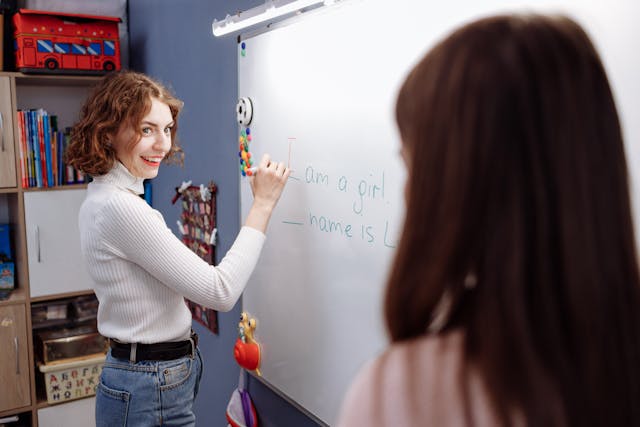
Another major reason one-on-one lessons improve speaking skills is simply the amount of speaking practice students receive. In a traditional classroom with many students, speaking time must be shared among the entire group. As a result, each learner may only have a few opportunities to speak during a class session.
In contrast, individualized lessons place the learner at the center of the interaction. Nearly every activity involves direct communication with the teacher, dramatically increasing the amount of time students spend actively using the language.
The research by Juspaningsih (2023) illustrates this clearly. Students reported that private lessons provide “more opportunity to speak compared to classroom learning, where only one or two students may speak because there are many people and limited time.”
This increased speaking time is essential for developing fluency. During one-on-one lessons, teachers can engage learners in a wide range of communicative activities such as role-playing real-life situations, retelling stories or films, describing images, answering questions, and discussing daily experiences. These activities encourage learners to produce language actively rather than simply listening or completing written exercises.
At Language Trainers, real conversation in language teaching is central to our approach. Because our lessons are personalized and interactive, students spend much more time speaking and practicing real communication. Over time, this increased participation helps learners build confidence, improve pronunciation, and develop the fluency needed to use the language naturally in everyday situations.
The Academic Benefits of Individual Language Instruction
Beyond improving speaking confidence, individualized language instruction also provides significant academic advantages. Language learning often involves overcoming specific gaps in vocabulary, grammar, pronunciation, or comprehension. In large classrooms, teachers must divide their attention among many students, making it difficult to address each learner’s individual challenges. As a result, misunderstandings may go unnoticed and progress can slow.
Individual instruction changes this dynamic by allowing teachers to work closely with one learner at a time. This approach enables instructors to identify difficulties quickly, provide immediate feedback, and design exercises that directly address the learner’s needs. Research in language education has shown that this type of targeted support can improve both academic outcomes and student engagement, particularly for learners studying a second language.
Evidence That Individual Instruction Improves Academic Performance
Studies in education consistently show that individualized support can significantly improve academic performance for language learners. In the research project “Effects of One-on-One Support for English Language Learners through Collaboration, Compassion, and Engagement,” researcher Jocelyn Chiquito (2023) examined how direct teacher support affects English language learners in school settings.
The study found strong evidence that one-on-one instruction improves academic progress by providing individualized and targeted guidance. As the research explains, “one-on-one support is generally considered to be the most effective way of increasing student achievement.”
This improvement occurs because teachers can identify learning gaps more precisely when working with one student at a time. Instead of delivering the same explanation to an entire class, instructors can focus on the exact concept a learner is struggling with—whether it involves grammar, pronunciation, or comprehension.
The study also found that students receiving one-on-one support tend to show measurable academic progress, as teachers can provide explicit and targeted instruction designed to close learning gaps.
This principle is central to the Language Trainers teaching method. By working individually with each student, our instructors can identify weaknesses early and adapt lessons to strengthen those areas. This targeted approach allows learners to build a solid foundation in the language rather than progressing with unresolved gaps.
Why Personalized Support Accelerates Language Progress
Personalized instruction accelerates language learning because every lesson is designed around the learner’s specific needs. In a group classroom, teachers typically follow a fixed curriculum that moves at a pace determined by the entire class. Some students may find the material too easy, while others may struggle to keep up.
In one-on-one lessons, however, the pace can be adjusted continuously. Teachers can slow down when a learner needs more explanation or move forward more quickly when concepts are mastered. This flexibility allows lessons to remain both challenging and achievable.
Research on individualized language instruction highlights the importance of this targeted approach. Chiquito (2023) explains that one-on-one support allows educators to provide “individual, explicit, and targeted instruction” that helps learners meet their academic goals and make measurable progress.
This type of instruction also allows teachers to address specific language issues immediately. Vocabulary gaps can be filled through contextual conversation practice. Pronunciation problems can be corrected in real time. Grammar misunderstandings can be clarified through examples tailored to the learner’s communication goals.
At Language Trainers, this personalized approach ensures that each lesson focuses on what the learner needs most. Instead of following a rigid curriculum, instructors adapt materials, exercises, and conversations to the student’s objectives—whether that involves professional communication, travel preparation, or everyday conversation. By focusing directly on the learner’s challenges and goals, personalized instruction allows language progress to happen more efficiently and naturally.
The differences between one-on-one lessons and group classes become even clearer when you compare how each format handles speaking time, feedback, pacing, and learner confidence:
| Learning factor | One on one lessons | Group classes |
| Speaking time | High speaking time in every lesson | Speaking time shared across the class |
| Feedback | Immediate and personalized | Less frequent and less individualized |
| Lesson pace | Adjusted to the learner’s speed | Set according to the group’s overall pace |
| Lesson content | Built around personal goals and weak points | Usually follows a fixed curriculum |
| Confidence building | More comfortable space to ask questions and make mistakes | Some learners participate less because they feel self-conscious speaking in front of others |
| Teacher attention | Fully focused on one learner | Divided across multiple students |
Benefits of Face-to-Face Language Learning
Research in second language acquisition has long examined whether students learn equally well in online environments and traditional classroom settings. While online instruction offers flexibility, many studies highlight the pedagogical advantages of in-person learning, especially for skills that depend heavily on interaction such as speaking and listening.
Face-to-face language classes create an environment where learners engage continuously with instructors and classmates. Questions receive immediate answers, misunderstandings are corrected in real time, and communication happens naturally through conversation and classroom activities. These factors play an important role in language development because interaction helps learners process meaning, notice errors, and refine their language use.
A study published in ELIA – Estudios de Lingüística Inglesa Aplicada (Studies in Applied English Linguistics) examined this question by comparing Spanish learners studying in online environments and traditional face-to-face classes. The research was conducted by Dr. Mariche Bayonas of the University of North Carolina Greensboro (USA) and analyzed both students’ perceptions of learning and their academic results.
Research Comparing Face-to-Face and Online Language Classes
The study investigated how university students perceived their own learning when studying Spanish as a second language in face-to-face (F2F) versus online (OL) environments. Although many participants expressed general satisfaction with both formats, the results showed clear differences in how students evaluated their learning experience.
According to Bayonas, “their self-reported perception of learning is lower for OL students than F2F participants.” The research further explains that a higher percentage of face-to-face students reported stronger satisfaction with their course format and learning experience.
These findings highlight the importance of direct interaction in language learning environments. In face-to-face classes, students participate in communicative activities such as role-playing, group discussions, and spontaneous conversations that allow them to practice language actively. These activities create continuous opportunities for learners to receive immediate feedback and clarification.
At Language Trainers, this principle plays a central role in our teaching method. Language Trainers prioritizes face-to-face instruction because real-time human interaction gives learners more immediate feedback, more natural conversation practice, and a more immersive learning experience.
Face-to-face interaction creates a learning experience that feels more present and immersive than remote or passive forms of study. Students interpret facial expressions, gestures, tone of voice, and subtle cues that accompany spoken language. This multisensory interaction engages more cognitive processes at the same time. Listening, speaking, observing, and responding occur together in real time.
Because the learner is physically present with the instructor, attention remains focused on the conversation rather than divided among screens, notifications, or other distractions. The exchange becomes more dynamic and emotionally engaging. Learners respond not only to words but to the rhythm, expression, and social context of communication. This heightened level of attention and emotional involvement strengthens memory formation and helps learners internalize new vocabulary, pronunciation patterns, and sentence structures more effectively.
What Happens Inside Effective One-on-One Language Lessons
A key element of the Language Trainers teaching method is the structure of the lesson itself. Instead of relying on passive learning or rigid textbook exercises, our courses focus on interactive one-to-one language lessons designed around real communication.
Research in language acquisition and educational psychology consistently shows that personalized instruction improves learning outcomes because teachers can respond directly to each learner’s needs. In a one-to-one environment, students receive immediate feedback, participate more actively, and practice the language far more frequently than in traditional group classes.
This is why personalized language instruction has become one of the most effective methods for developing real communication skills.
Speaking Activities That Develop Real Communication Skills
In effective one-to-one language lessons like those used by Language Trainers, speaking activities are designed to simulate real communication rather than isolated grammar drills.
Research by Jocelyn Chiquito (California State University Monterey Bay) in the study “Effects of One-on-One Support for English Language Learners through Collaboration, Compassion, and Engagement” (2023) highlights the importance of engagement in language learning. The research found that students who actively participate in personalized instruction show stronger academic outcomes, noting that higher levels of student engagement are associated with improved performance and achievement.
This supports the communicative approach used in Language Trainers lessons, where students practice language through realistic speaking activities such as:
- Role-playing real-life situations such as business meetings, travel conversations, or social interactions
- Describing images or events to build vocabulary and fluency
- Storytelling and narrative exercises that develop structured speaking
- Guided conversations and open discussions
- Question-and-answer exchanges that encourage spontaneous communication
These activities mirror the way language is used in real life. Instead of memorizing isolated grammar rules, learners practice expressing ideas, responding to questions, and maintaining natural conversations.
Because students are actively using the language throughout the lesson, they build fluency, listening comprehension, and confidence simultaneously.
How Personalized Language Lessons Adapt to Each Learner
Another major advantage of one-to-one language learning is the ability to tailor lessons to the individual student. In group classes, instructors must divide attention among many learners and follow a standardized curriculum. In contrast, private instruction allows teachers to adjust every aspect of the lesson to the learner’s needs.
In the Chiquito (2023) study, researchers found that one-to-one support allows educators to provide individual, explicit, and targeted instruction that addresses each student’s learning challenges. The research concluded that personalized support helps learners make measurable academic progress and close learning gaps more effectively than generalized instruction.
This kind of differentiated learning is at the heart of the Language Trainers method. By combining scientifically supported one-to-one instruction with communication-focused practice, our language courses create a learning environment where students can develop language skills more efficiently and with greater confidence.
Evidence That Face-to-Face Students Achieve Higher Scores
The study did not rely only on student perceptions. It also analyzed 352 final exam scores from students enrolled in Spanish courses taught either online or face-to-face. All students completed the same exams, which measured proficiency in the four key language skills: listening, speaking, reading, and writing.
The results showed a clear academic difference between the two groups. Bayonas reports that students enrolled in face-to-face courses obtained statistically higher final exam scores than those studying online. As the study concludes, “participants in F2F classes obtained statistically significant higher scores than participants in OL classes.”
This difference is closely linked to the structure of face-to-face classes described in the research. In traditional classrooms, students spend more time participating in communicative activities that develop oral interaction and listening comprehension. By contrast, the study notes that online learners often have fewer opportunities for real-time oral interaction, which may limit the development of certain language skills.
These findings reinforce an important idea in language education: language develops most effectively through active communication with other people. Face-to-face learning environments naturally create these communicative conditions.
The teaching method used by Language Trainers reflects this research. Our approach prioritizes direct interaction between teacher and student through personalized lessons and, whenever possible, face-to-face instruction. This structure mirrors the conditions identified in academic research as most supportive of language development: real-time communication, immediate feedback, and frequent opportunities to practice speaking.
How Psychological Safety Helps You Learn a Language Faster
Language learning exposes learners to a level of vulnerability that does not appear in many other academic subjects. Students must speak before they feel ready, produce imperfect sentences, and communicate ideas with limited vocabulary. In this process, mistakes are unavoidable and highly visible. For many learners, this creates anxiety and reluctance to participate.
Research in second language acquisition increasingly recognizes that emotional conditions strongly influence learning outcomes. Language learning is not purely a cognitive process. It is deeply connected to motivation, confidence, and emotional engagement.
A recent study by Fernando D. Rubio-Alcalá, Natalia Velázquez-Ahumada, and Francisco Javier Ávila-López, published in the journal ELIA (Estudios de Lingüística Inglesa Aplicada), investigates how basic psychological needs shape emotions in foreign language learning environments. Drawing on Self-Determination Theory, the researchers analyze four key psychological needs that influence learning: autonomy, competence, relatedness, and novelty.
The study shows that these psychological needs directly influence the emotions learners experience while studying a language. As the authors explain, “emotions play a major role in the process of learning a foreign language.” Their analysis demonstrates that students’ perception of competence plays a particularly central role in shaping emotional responses. When learners feel capable of using the language, positive emotions increase. When they feel incapable or exposed, negative emotions such as anxiety and frustration emerge.
The researchers explain that “competence emerged as the most influential predictor of enjoyment and pride in the foreign language classroom.”
This finding has important implications. Language learners do not progress simply by receiving more information or completing more exercises. Progress depends heavily on whether learners feel capable of participating in communication.
The study further shows that satisfaction of psychological needs increases positive emotions associated with learning. In particular, the researchers note that “the satisfaction of basic psychological needs is associated with greater enjoyment and pride and with lower levels of anxiety.”
These emotional responses matter because they influence how actively learners participate in the learning process. Students who feel confident speak more, experiment more with the language, and remain motivated for longer periods of time.

Why One-to-One Lessons Create the Right Emotional Conditions
The psychological dynamics described in this research help explain why one-to-one language instruction often produces stronger learning outcomes than traditional group classes.
In large classroom environments, learners must speak in front of peers, compete for attention, and risk embarrassment when making mistakes. This environment can undermine the psychological need for competence and reduce students’ willingness to participate.
Personalized one-to-one lessons create a different learning environment. The interaction between teacher and learner becomes collaborative rather than performative. Mistakes are treated as part of the learning process rather than public errors.
This structure supports the psychological needs identified in the research:
Competence grows through immediate feedback and individualized explanations.
Autonomy increases because lessons adapt to the learner’s goals and pace.
Relatedness develops through direct teacher–student interaction.
Positive emotions replace anxiety as learners gain confidence.
When these psychological needs are satisfied, students become more willing to speak, experiment, and communicate. In other words, the environment itself becomes a catalyst for language acquisition.
This is precisely the learning environment that Language Trainers’ personalized courses are designed to create. By focusing on one-to-one instruction, real conversation practice, and individualized teaching strategies, Language Trainers aligns its teaching model with the psychological conditions that research identifies as essential for successful language learning.
Personalized Language Learning: Key Takeaways from the Science
Scientific research in language acquisition and educational psychology consistently shows that effective language learning depends on three key factors: meaningful interaction, personalized instruction, and strong learner engagement. The teaching model used by Language Trainers is built around these principles.
Studies in second language acquisition demonstrate that learners progress more effectively when lessons encourage active participation, individual support, and emotional engagement with the learning process. Instead of passive listening or rigid curriculum structures, successful language instruction creates an environment where learners feel confident, motivated, and personally involved in the learning experience.
The Language Trainers method reflects these findings by combining one-to-one instruction, real conversational practice, and flexible course design. Every lesson focuses on interaction between teacher and learner, allowing immediate feedback, adaptive teaching strategies, and constant speaking practice. This structure directly supports the psychological conditions that research identifies as essential for language learning success.
Key Scientific Insights Supporting Personalized Language Learning
Research in educational psychology and second language acquisition highlights several factors that strongly influence language learning outcomes.
- Learner autonomy improves motivation. When students feel control over their learning process, they participate more actively and remain engaged for longer periods of time.
- Perceived competence increases learning success. Students who feel capable of using the language develop stronger confidence and sustain higher levels of motivation.
- Social interaction strengthens language acquisition. Direct interaction with teachers encourages meaningful communication and improves speaking and listening development.
- Positive emotions support cognitive performance. Enjoyment and pride during learning correlate with higher levels of engagement and better academic outcomes.
- Personalized instruction reduces learning barriers. Individualized teaching allows instructors to identify difficulties quickly and adjust explanations, exercises, and pacing accordingly.
These factors align closely with the structure of Language Trainers courses, where lessons revolve around one-to-one interaction, customized learning goals, and real conversational practice.
A Real Success Story from One of Our Language Learners
Research findings about autonomy, competence, and personalized instruction become clearer when viewed through real learning experiences. Language Trainers works with learners whose goals vary widely. Some students prepare for professional environments, others study for academic purposes, and many learn a language for personal connections or travel. In every case, the course design adapts to the individual learner rather than forcing students into a fixed curriculum.
The experience of James Wolf, a U.S. Army officer in the California National Guard and a web producer at California State University, illustrates how personalized instruction supports specific goals. James began studying French in San Diego because his wife is from France and her family does not speak English. His objective was not academic certification or grammar mastery. His goal was practical communication with his in-laws. After experimenting with self-study programs, he turned to Language Trainers because he wanted faster progress with guidance from a qualified instructor. As James explains, “I had used a few self-learning programs like Rosetta Stone and Pimsleur, but I just was not learning as fast as I wanted to. When I heard about Language Trainers and how they recruited tutors from actual educational institutions I figured it was worth a try.”
His face-to-face French course was structured around short, frequent sessions and personalized content. Instead of following generic textbook exercises, the instructor focused on the situations James would encounter with his wife’s family. The lessons were adapted to his learning style and communication needs. As he describes, “The teacher was amazing. She tailored each lesson based on my needs and focused specifically on topics that I would need. And she adjusted to my unique learning style as well. I’m a kinetic and auditory learner so we did muscle memory and listening exercises over flashcards.”
After two months of lessons, James traveled to France and was able to communicate with his in-laws in their native language. Reflecting on the experience, he said, “I studied with the tutor three times a week for two months and learned enough in that time to hold short conversations with my in-laws in their native tongue. I was really surprised how fast I was able to start applying the language.”
Experiences like James’s demonstrate how personalized language training translates research principles into practical results. By adapting lessons to each learner’s goals, communication contexts, and learning style, Language Trainers creates a learning environment where students develop the competence and confidence that research identifies as essential for successful language acquisition.
→Sign Up Now: Free Trial Language Lesson With a Native Teacher!←
Would you like to experience this kind of personalized language learning yourself? Language Trainers offers one-to-one in-person language lessons with native teachers who tailor every class to your goals, schedule, and learning style. Whether you want to learn a language for professional communication, academic study, travel, or personal connections, our customized courses help you progress quickly and confidently. Contact Language Trainers today to arrange a free trial lesson and discover how personalized instruction can accelerate your language learning journey.
Frequently Asked Questions About Personalized Language Learning
1. Is one-to-one language learning more effective than group classes?
Yes. Research in language acquisition shows that one-to-one language instruction increases speaking time, feedback frequency, and personalized guidance. Because the learner becomes the central participant in the lesson, teachers adapt explanations, pacing, and exercises to the student’s needs. This structure often leads to faster progress and stronger speaking confidence than traditional group classes.
- Why does personalized language instruction help students learn faster?
Personalized language instruction accelerates learning because teachers focus directly on the learner’s goals and weaknesses. Instead of following a fixed curriculum designed for large groups, instructors adjust activities, explanations, and practice based on the student’s progress. This targeted approach improves comprehension, strengthens speaking practice, and reduces time spent on material the learner already understands.
3. Does learning a language later in life benefit brain health?
Yes. Scientific research shows that learning a new language in old age stimulates multiple areas of the brain involved in memory, attention, and problem-solving. Studies in cognitive science suggest that language learning strengthens neural connections and may contribute to cognitive resilience in older adults. Many researchers associate bilingualism with improved mental flexibility and a delayed onset of age-related cognitive decline.
4. How long does it take to learn a new language?
The time required to learn a language depends largely on the learner’s goal and the difficulty of the language. Different purposes require different levels of fluency. Someone preparing for travel or everyday conversations may reach a functional level much faster than someone aiming for professional or academic fluency.
One widely cited benchmark comes from the U.S. Foreign Service Institute (FSI), which studies how long it takes English speakers to reach professional working proficiency in different languages. The FSI groups languages into categories based on their difficulty for English speakers.
For example, Category I languages such as Spanish, French, and Italian typically require around 600–750 classroom hours to reach professional proficiency. Category III languages such as Russian or Turkish require closer to 1,100 hours. Category IV languages, including Arabic, Chinese, Japanese, and Korean, may require 2,200 hours or more because of differences in writing systems, grammar, and pronunciation.
These estimates refer to high-level professional fluency. Many learners reach useful conversational ability much sooner, especially when lessons focus on real communication and personalized practice.