Search Results

American vs British English, the war rages on

British comedian David Mitchell, best known for his role in cult British TV show Peep Show as well as being a frequent guest on panel quiz shows, is also famous for his wit and bile-fuelled rants about society in general. His “David Mitchell’s Soap Box” series has gained quite a bit of fame on YouTube. [...]

Comments

Annoyances: the difference between “there it is” and a background murmur

I’ve stumbled across this in written English many times – for when somebody wants to announce “there it is”, English borrowed the French word “voila” (not to be confused with a “viola”, the stringed instrument one size larger than a violin). “Voila” literally means “see there”, and comes to mean “there it is” or, more [...]

Comments

Annoyances: piqued/peaked and other confusions

My last “annoyances” post about confusing wreck and wreak made me think a little about other words that are often confused with each other in daily use. A lot of the confusion seems to stem from the fact that one of the words is used in an English idiom – a set phrase, for example [...]

Comments

Annoyances: wreak vs wreck

Just a short post here about something that either I’ve been hearing more often as of late, or simply been noticing more often: the difference between the words wreck and wreak. Wreak is almost always only heard in the popular idiom “to wreak havoc”, which means to inflict devastation or damage to something or someone. [...]

Comments

Tautological and autological

This is a slightly more in-depth grammarian kind of post than usual, but I hope it’s still interesting! Two useful grammatical terms used when discussing certain words and phrases refer to tautology and autology. While the terms sound similar, they have very different meanings. Tautology (sometimes also called circumlocution) is used to describe a phrase [...]

Comments

Annoyances: imply/infer

One language error that is often seen, not only in high school essays across the USA but in many places that should possibly know better, is the confusion of the two words imply and infer. Many think these two words mean essentially the same thing, but in fact the words are almost antonyms. Put simply, [...]

Comments

Fun sites for helping you with English grammar

Source: lifehacker.com Smartening up your grammar skills doesn’t have to be a boring affair – in a previous post I linked to humor site The Oatmeal for their guide to correct apostrophe use, presenting the rules of one of the most oft-misused marks of punctuation in a series of bizarre and surreal cartoons. Lifehacker.com – [...]

Comments

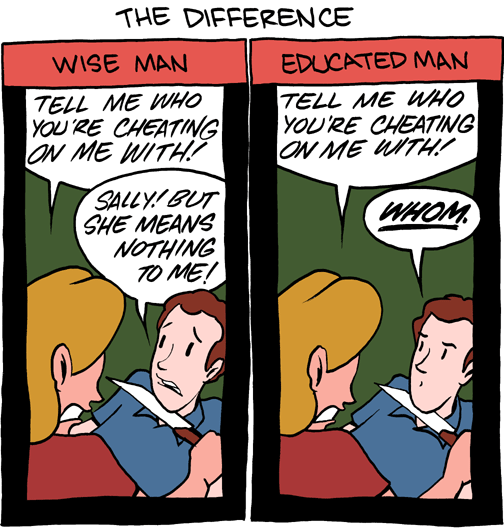
Annoyances: who/whom

Source: smbc-comics.com One of my favourite webcomics, Saturday Morning Breakfast Cereal, recently updated with a brilliant strip relating to this particular annoyance. To be honest, this one doesn’t particularly bother me. The key is in the difference between the nominative and objective cases for nouns in English – and in 99.9% of circumstances, words in [...]

Comments

English grammar myths

OK, so I might go a little overboard with my grammar Nazism sometimes (which I guess can be seen in a lot of my “annoyances” posts). However, the only thing worse than a pedant is an incorrect pedant – a stickler to the rules that is not aware of the correct rules themselves. English is [...]

Comments

Annoyances: to/too

I suppose that this one is going out of fashion, since I’m seeing more and more ‘txtspk’ online these days, with people simply replacing any instance of the words ‘to’ or ‘too’ with the number 2… but it still annoys me anyway! “Too” can either mean ‘in addition’ or ‘to an excessive degree’. For example, [...]

Comments

« Previous entries Next Page » Next Page »